
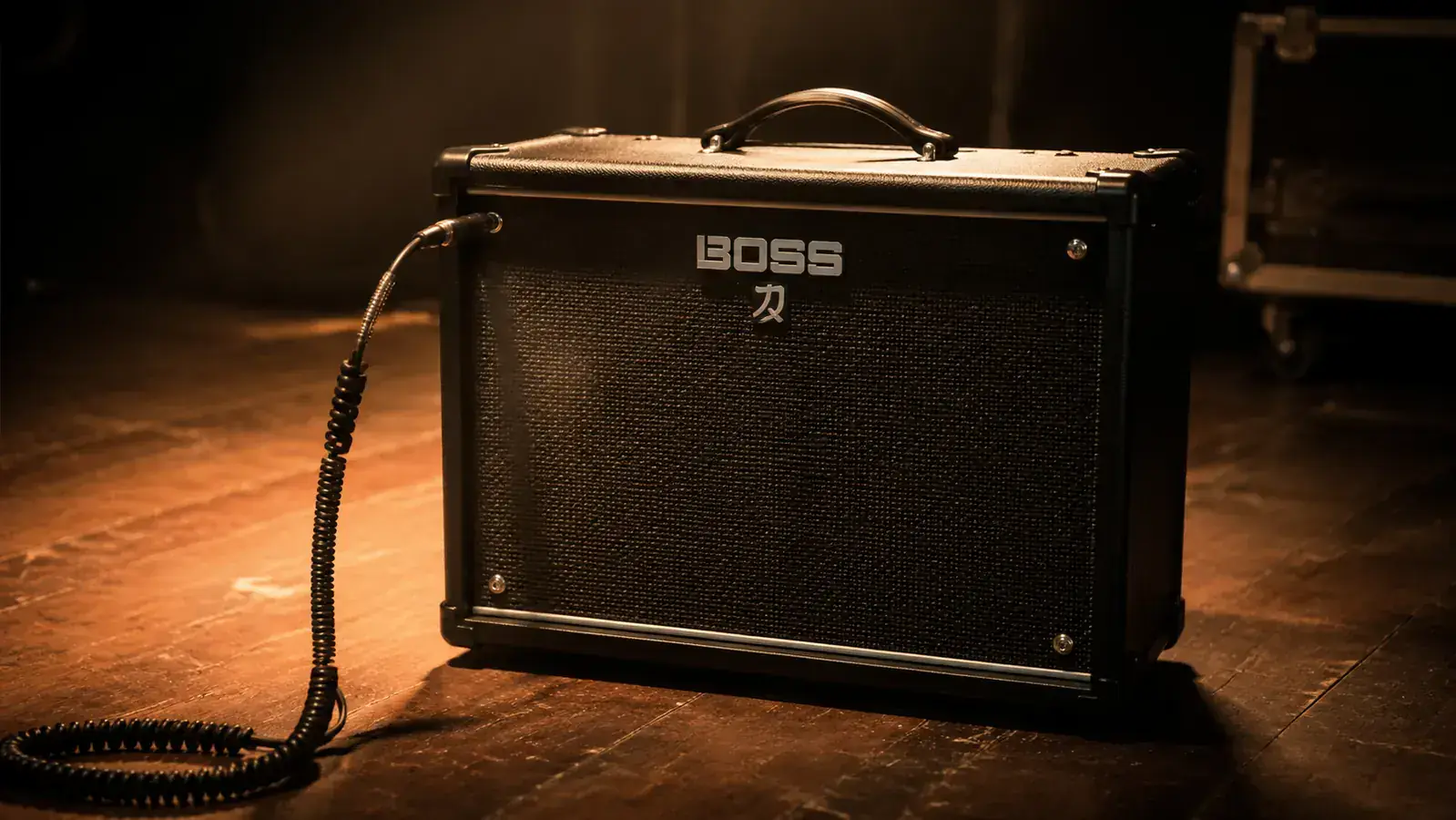
Let me be straight with you about something. The Boss Katana MkII-50 gets more Reddit upvotes than any amp has a right to, and most of those posts are from people who bought it three weeks ago and are still in the honeymoon phase. I've owned mine long enough to find its edges. Some of them are minor. A couple of them legitimately made me think about returning it. I didn't return it, but I thought about it. That's the kind of honest I'm going to be here.
The Katana MkII-50 is a 50-watt, 12-inch speaker combo amp with five amp voices, a built-in effects section, and Boss's Tone Studio software for deep editing. It costs around $350 on Amazon right now. For that money it's remarkable. But 'remarkable for $350' and 'perfect' are two very different sentences, and most reviewers collapse them into one. I'm not going to do that.
The Quick Verdict
A genuinely great amp for bedroom players and small rehearsals, hamstrung by a noisy fan, a software workflow that takes real time to learn, and a reverb section that sounds like an afterthought.
Amazon Check Today's Price →If you've read enough and want to check current pricing, here's the Katana MkII-50 on Amazon.
It's usually in stock and ships quickly. Read the full review below before you decide, though.
Amazon Check Today's Price on Amazon →How I've Used It
I run a Telecaster and a Les Paul through this thing, mostly at home in a medium-sized room, and occasionally at low-volume rehearsals with a drummer who plays with brushes. I've run pedals in front of it, used the built-in effects, spent hours inside Tone Studio, and tested every wattage mode from 0.5W to 50W. I've also A/B'd it against my Vox AC15 on multiple occasions, which I'll get to.
What I have not done is play it at a loud band rehearsal with a full-kit drummer. And that, it turns out, is a material limitation. The 50W spec looks impressive on paper, and against other modeling amps in this price range it is. Against a drummer who actually hits things, it's a different conversation.
The Fan Noise Nobody Mentions
Here's the first thing I wish someone had warned me about: this amp has a cooling fan, and that fan runs constantly. At bedroom volume, especially in the 0.5W or 5W modes, the fan is audible. Not catastrophically loud, but it's there. A low, steady hum sitting underneath everything. When you're riffing loud it disappears. But in quiet passages, in between takes when you're listening back to something, or when you're noodling at 10 o'clock at night, you can hear it.
This matters for recording more than anything else. If you've got a microphone anywhere near this amp and you're trying to capture a quiet clean guitar part, that fan is going to show up in your recording. It's not a dealbreaker for live use, but it's the kind of thing that makes you understand why serious home recordists still run their signal through an interface and a cab sim plugin instead. The Katana's built-in cab sim output is fine, but the fan is still running.
This isn't a defect. It's a design choice for thermal management. But no YouTube reviewer I've seen spends 60 seconds on it, and it's one of the first things you'll notice when you plug in at low volume.
Tone Studio: Powerful, But Plan to Spend an Afternoon
The Tone Studio software is free, it works, and once you understand it, it genuinely opens up the amp. There's a signal chain editor, an effects library, patch storage for up to 15 memory slots, and the ability to fine-tune things like speaker resonance and presence that you can't touch from the front panel. For a $350 amp, that's an absurd amount of control.
But the learning curve is real, and the workflow between the software and the physical knobs is where most people get confused. Here's the core tension: the amp has five physical amp voice buttons and a set of physical knobs for gain, bass, mid, treble, volume, and master. Those knobs do exactly what they say. But when you load a saved patch from Tone Studio, those physical knobs no longer reflect the patch settings. Turn the gain knob and you're now overriding the saved patch value. It sounds obvious in writing, but in practice it takes a while to internalize, and until you do you'll spend time wondering why your saved patch sounds different than you remembered.
The Tone Studio software unlocks a genuinely impressive amount of control for a $350 amp. The catch is that it takes real time to learn, and the relationship between the software patches and the front-panel knobs is confusing until it clicks.
The other thing Tone Studio gets you is access to the full effects library. The amp ships with eight effects slots active in the signal chain, but there are many more effects available in the software. The chorus sounds good. The delay sounds good. The built-in noise gate works reasonably well. But the reverb, which I'll get to separately, is the weakest link in the whole effects section.
The 'Brown' Amp Model Is Not What You Think
The five amp voices are Clean, Crunch, Lead, Brown, and Acoustic. The Clean voice is genuinely excellent, especially with single-coils. The Crunch voice gives you a convincing British crunch that works well for classic rock. Lead is compressed and singing in a way that suits lead work without getting too fizzy.
Then there's Brown. It's named after Eddie Van Halen's famous brown sound, and that name does a lot of work for Boss's marketing because every guitarist under 60 knows what that implies. I'm here to tell you the Katana's Brown mode is fine, but it does not sound like a cranked Marshall with a variac and a 1970s Les Paul. It sounds like a high-gain modeling amp channel. It's thicker and more compressed than Lead, and the top end has a particular kind of synthetic smoothness that modeling amps get when they're working hard. Players who know what the original brown sound actually is, from the recordings, will find this falls short. Players who just want a warm, high-gain lead tone will probably be happy with it.
That gap between the name and the reality is worth knowing before you hand over your money expecting EVH on tap.
The Reverb Is the Weakest Link
I want to spend a minute on the reverb because it's the effects section element that disappoints me most. The Katana's reverb is functional. You can hear it working. But it has a particular quality that I'd describe as artificial and slightly thin, where the decay has a digital texture that calls attention to itself in a way that good reverb shouldn't. Spring reverb, even modeled spring reverb, should feel like the sound is sitting in a physical space. The Katana's reverb sounds like the sound is being processed.
For heavy rock where you're drowning everything in gain anyway, this doesn't matter much. But if you play clean or lightly broken-up stuff where reverb is a primary part of your tone, you'll want a dedicated reverb pedal in front of this amp. The Boss RV-6 pairs with it well and costs around $130. Budget for it.
50 Watts: The Volume Reality Check
The spec sheet says 50 watts. That sounds like plenty. And against another modeling amp or in a bedroom, it is. But there's a persistent misunderstanding among people who haven't played through a lot of different amps: solid-state watts are not tube watts, and wattage alone doesn't tell you how loud an amp sounds or how much headroom it has.
A 50-watt solid-state amp running a 12-inch speaker can be pushed by an energetic drummer with a full kit. I've heard from multiple Katana owners in band contexts who ended up with the master volume pinned and still felt like the amp was getting buried. If your drummer hits hard and your rehearsal space is not mic'd through a PA, the Katana 50 may not cut it. The Katana 100 with its two 12-inch speakers is a different animal. But the 50 is, in practice, a practice amp that can handle low-volume rehearsals, not a rehearsal amp that can handle moderate gigging.
This isn't a criticism, exactly. Boss positions this amp for home use and it delivers on that. But the name '50' implies headroom that real-world rehearsal scenarios will test.
Why Some Players Go Back to a Vox AC15
I have an AC15 sitting six feet from the Katana and I A/B them regularly. The AC15 costs roughly twice the price of the Katana, uses actual tubes, and has a character that modeling still doesn't fully replicate. When I plug my Telecaster into the AC15's Normal channel with the treble turned down and the master just starting to breathe, there's a dynamic response and a three-dimensional quality that the Katana, at its best, approximates but doesn't equal.
The reason some players buy a Katana, live with it for a few months, and then go back to a tube amp is not because the Katana is bad. It's because the feel of playing through a real output transformer into a real speaker cone, with real tubes compressing under your fingers, does something to the way you play. Notes breathe differently. The amp reacts to your picking attack in a way that modeling hasn't fully figured out yet. For some players, especially ones who have spent years playing through tube amps, that feel is not optional.
If you've never played a great tube amp, the Katana will seem extraordinary, because relative to solid-state amps it is. If you have played a great tube amp regularly, the Katana will seem very good but slightly flat. Which player are you? The answer to that question will probably tell you whether the Katana is your long-term amp or a stepping stone.
What I Liked
- Five distinct amp voices cover a genuinely wide range of tones
- Clean channel is excellent, especially with single-coils
- Power soak modes (0.5W, 5W, 50W) let you genuinely match any volume situation
- Tone Studio gives you deep patch control for free once you learn it
- Built-in effects section covers most common needs without any extra pedals
- At $350, the feature set is hard to beat anywhere near this price point
- Direct recording out with cab sim sounds usable without a dedicated interface
Where It Falls Short
- Cooling fan is audible at low volumes, shows up on microphones in quiet recordings
- Tone Studio learning curve takes real time, physical knob vs. patch workflow is confusing at first
- Reverb sounds artificial and thin compared to a dedicated reverb pedal
- Brown amp model doesn't live up to its Eddie Van Halen name for players who know the original
- 50W solid-state can get pushed by a hard-hitting drummer in a rehearsal room without PA support
- Lacks the dynamic feel and pick-attack response of even a modest tube amp
Who This Is For
The Katana MkII-50 is built for players who practice at home more than they gig, who want to cover a wide range of tones without buying multiple amps or a large pedalboard, and who are comfortable spending a few hours with software to unlock the full capability of what they own. Bedroom players, apartment dwellers, home studio guys who want to record direct, beginners who are ready to move past a starter amp, and weekend players who mostly jam at home will all get enormous value from this amp. At its price point there's nothing that matches it.
Who Should Skip It
Players who gig regularly with a full-volume drummer and need an amp that can hold its own without a PA are going to outgrow the 50 version quickly. Players who record acoustic or quiet clean guitar seriously and need a dead-silent recording environment will be annoyed by the fan. Players who have been playing through tube amps for years and want that specific pick-attack feel will probably find the Katana slightly unsatisfying, no matter how good the tone looks on paper. And players who specifically want that Van Halen brown sound are going to be let down by the Brown mode.
If the Katana fits your situation, today's price on Amazon is worth checking before it moves.
It ships fast, the return window gives you time to actually form an opinion, and if you fall into the 'bedroom player who wants one amp to do everything' category, you'll probably keep it.
Amazon Check Today's Price on Amazon →