
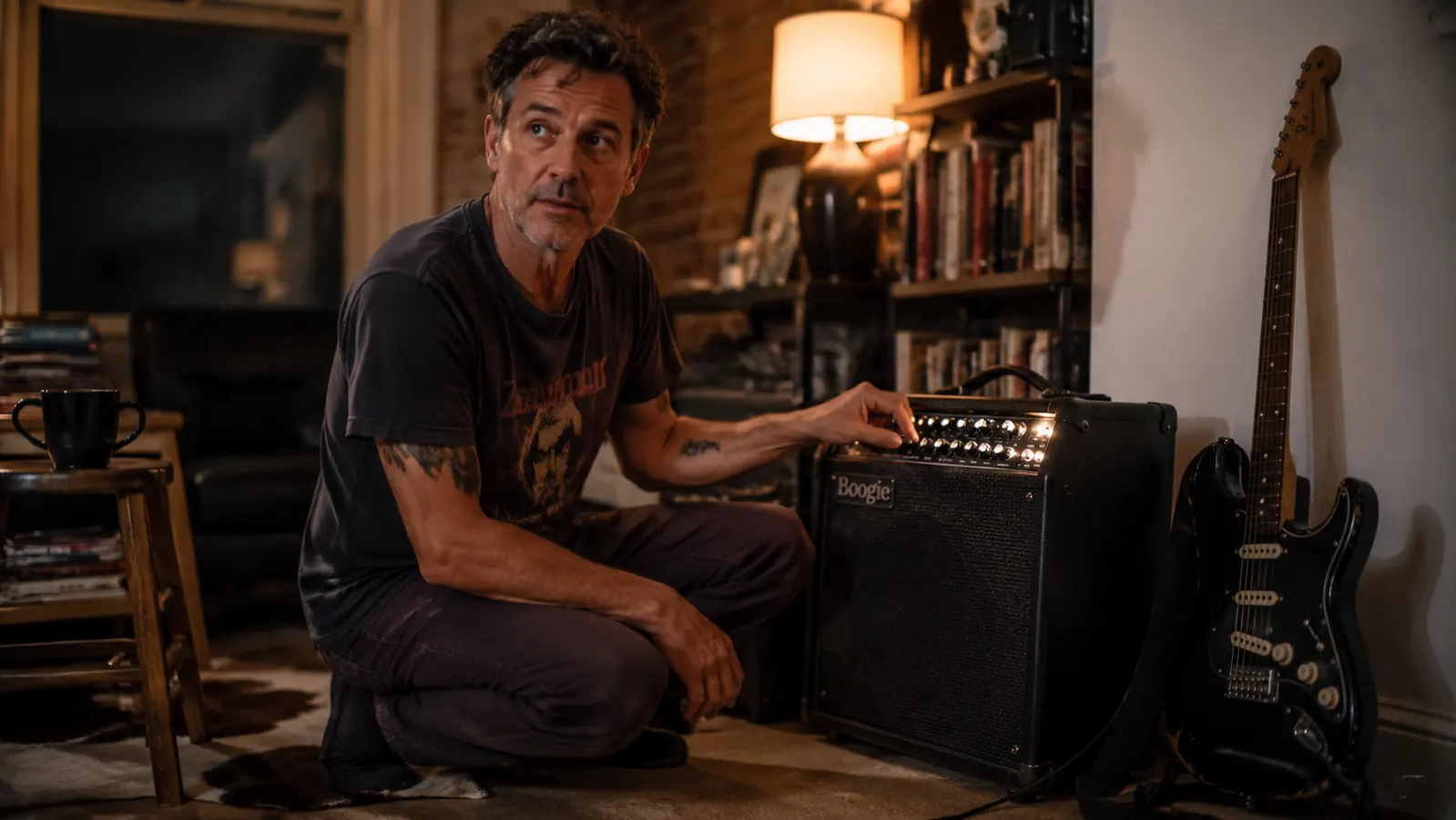
Here is the situation I keep hearing from players at every level: you want a solid practice amp that can do real rock tones, you have about $350 to spend, and you have narrowed it down to two names. The Boss Katana MkII-50 and the Fender Mustang GTX50 are the two modeling combos that come up most often at that price point, and both have genuine fans. I have spent time with each of them. My answer is the Katana, and I will explain exactly why without pretending the Fender does not have real strengths.
The short version: if you play rock, classic rock, hard rock, or anything with crunch and gain, the Katana MkII-50 gets there faster, sounds more convincing at bedroom volume, and does not require you to install software on your laptop just to access the amp's full potential. The Mustang GTX50 is a genuinely impressive amp with a better clean foundation and a more modern feature set, but it asks more of you up front, and the return on that investment depends heavily on whether you enjoy spending time in app menus.
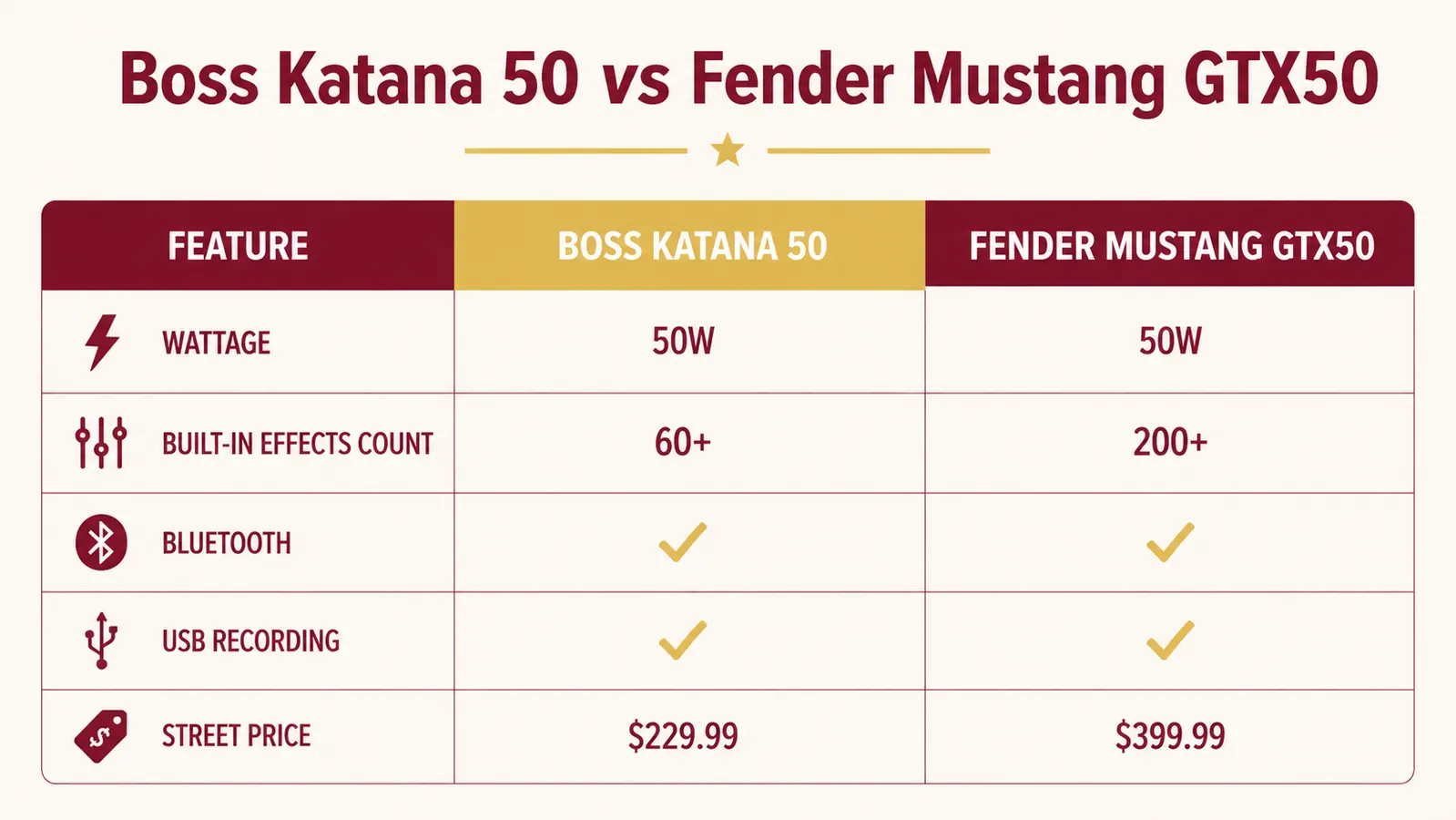
| attribute | left | right | winner |
| attribute | left | right | winner |
| attribute | left | right | winner |
| attribute | left | right | winner |
| attribute | left | right | winner |
| attribute | left | right | winner |
| attribute | left | right | winner |
| attribute | left | right | winner |
| attribute | left | right | winner |
| attribute | left | right | winner |
| attribute | left | right | winner |
| attribute | left | right | winner |
| attribute | left | right | winner |
Where the Boss Katana MkII-50 Wins
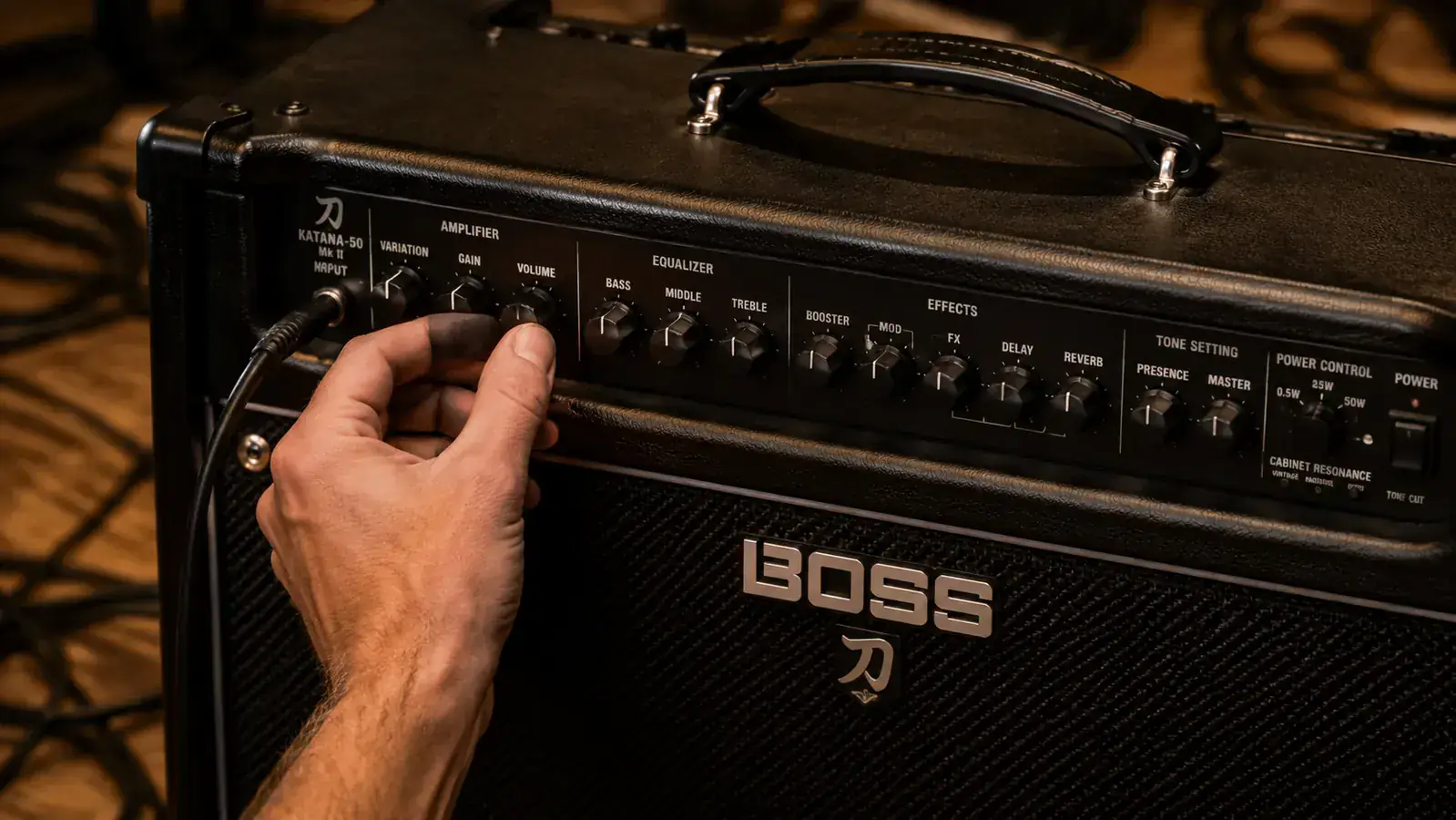
The single biggest advantage of the Katana is that the crunch and gain tones are ready the moment you plug in. Flip to the Brown channel, set gain around 2 o'clock, roll the presence up slightly, and you have a convincing British-stack-in-a-box tone that holds together at low volume in a way that surprises most players. The power amp section reacts to your guitar's volume knob like a real amp, not like a modeler approximating one. That is the detail that separates the Katana from a lot of its competitors, including the GTX50.
The wattage switching is also a bigger deal than most reviews acknowledge. The 0.5W mode is not a gimmick. It genuinely reduces the power section's headroom in a way that makes the amp feel and respond differently, not just quieter. At midnight in a townhouse, I can push the Katana's preamp hard at 0.5W and get tonal compression and sag that you simply cannot fake with a master volume knob. The Mustang GTX50 has no equivalent feature, and for late-night players or apartment dwellers, that is a meaningful gap. I covered more of this in my full six-month review at the link below.
Stop reading spec sheets and start hearing rock tone that's actually ready to go.
The Boss Katana MkII-50 has 4.7 stars from over 2,100 real players. Check today's price on Amazon and see if it's still in the $349 range.
Amazon Check Today's Price on Amazon →The effects loop is another point that gets overlooked in casual comparisons. The Katana's effects loop lets you run time-based pedals (delay, reverb, modulation) in the loop while keeping dirt in front of the amp. The GTX50 does not have a dedicated effects loop. If you are building a pedal-based rig and want the amp to stay clean in the power section while your pedals handle the saturation, the Katana accommodates that workflow. The GTX50 does not.
Where the Fender Mustang GTX50 Wins
The Mustang GTX50's clean tone is genuinely special. That Fender DNA runs deep, and the GTX50's clean channel has a clarity, sparkle, and harmonic richness that the Katana's clean mode approaches but does not quite match. If you play country, funk, blues with a clean foundation, or Strat-through-a-blackface-style tones, the GTX50 sounds more convincingly like the real thing. The Celestion speaker also contributes a slightly warmer, more organic breakup at the top end when you push it. That speaker choice matters.
The GTX50 also wins on total model count if you want variety for its own sake. With 100-plus amp models and effects onboard, it can approximate a wider range of tones when you invest the time in the Fender Tone app. Players who love tweaking presets, building setlists for different songs, or exploring wildly different amp characters will find more raw material in the GTX50. The app is well-designed once you learn it. The caveat is that you genuinely need to use the app to unlock that potential. Out of the box, the GTX50 is less immediately satisfying than the Katana.
The Katana plays like an amp. The GTX50 plays like a platform. Which one you want depends entirely on whether you enjoy being a platform administrator.
The Software Question
This is the honest conversation that most comparisons avoid. The Fender Tone app is not optional if you want to get the most out of the GTX50. You need a smartphone or tablet within Bluetooth range, you need to spend real time building or importing presets, and you need to accept that the amp's deepest features live behind a screen rather than on the panel. For players who already live in that world, it is fine. For players who want to walk to the amp, turn a knob, and play, the GTX50 adds friction at every step.
The Katana Boss Tone Studio software is optional. The amp ships with five usable amp characters and a full suite of effects running simultaneously without ever touching a computer. You can go deeper with the software, and the Boss Tone Studio gives you access to hundreds of community-built patches, but none of that is required to get a great rock tone on day one. That is a fundamentally different design philosophy, and for most rock players, the Katana's approach is the right one.
Tone Character at Low Volume
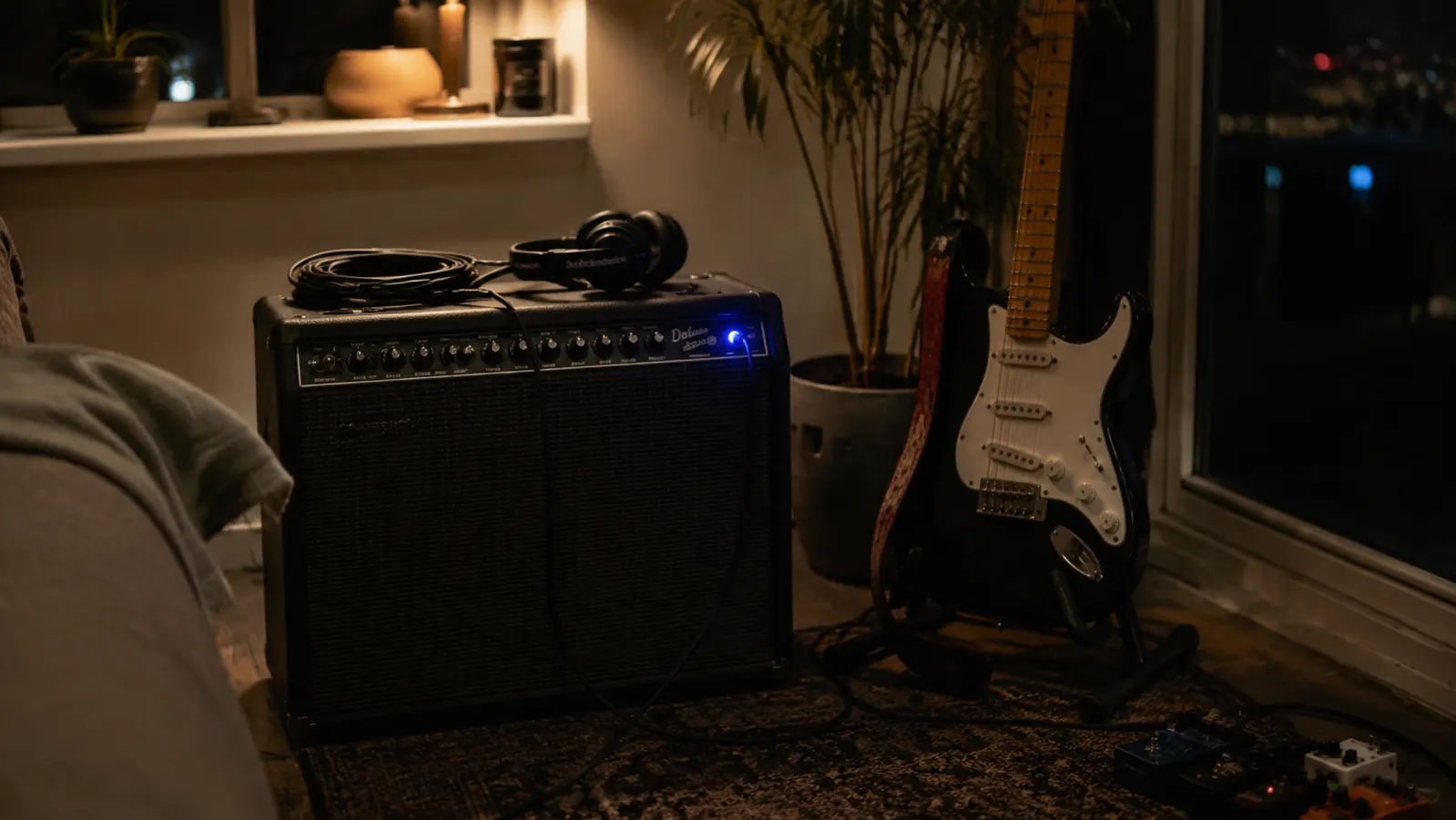
Most of us are playing at bedroom levels most of the time. Both amps have modeling-based speaker simulation at low volumes, but the Katana's Air Feeling function adjusts the cab simulation based on the master volume setting, so the low-end response and midrange presence compensate for the Fletcher-Munson effect as you turn down. In plain language: the Katana sounds more like itself at low volume than it does at gig volume, which is the right tradeoff for bedroom players. The GTX50 handles low-volume playing reasonably well, but it does not have an equivalent loudness compensation system.
For the recording side of things, both amps offer USB audio output with cab simulation. I have tracked through both. The Katana's recorded signal is thicker and more immediately usable for rock without EQ surgery after the fact. The GTX50's recorded output is cleaner and more neutral, which is better if you want to process heavily in your DAW. Again, the choice comes down to what you need the amp to do.
Who Should Buy Which
Buy the Boss Katana MkII-50 if you play rock in any of its forms, you want great tone without a learning curve, you play at low volume but still want power-amp feel, you use pedals and want a real effects loop, or you just want to plug in and play. That covers the majority of the people asking this question. The Katana is the better all-around rock amp at this price, and it has the track record to prove it.
Buy the Fender Mustang GTX50 if clean Fender tones are central to your playing style, you genuinely enjoy working inside a software editor and building customized presets, you primarily play country, blues, or funk where the clean channel matters more than the gain channel, or you want maximum tonal variety and are willing to invest time in the app to find it. The GTX50 rewards patience. The Katana rewards impatience. Both are legitimate choices, but they are not equally suited to the same player.
One thing worth knowing: check out my deep-dive guide on dialing in classic rock tones on a modeling amp if you end up with the Katana and want to nail specific tones from specific eras. I covered Zeppelin, AC/DC, and SRV settings in detail, and most of them apply directly to the Katana's channel structure.
The Boss Katana MkII-50 is the plug-in-and-play rock amp that 2,100 players have already figured out.
If you want crunch, wattage switching, an effects loop, and tone that works without an app, this is it. Check today's price on Amazon before it moves.
Amazon Check Today's Price on Amazon →