
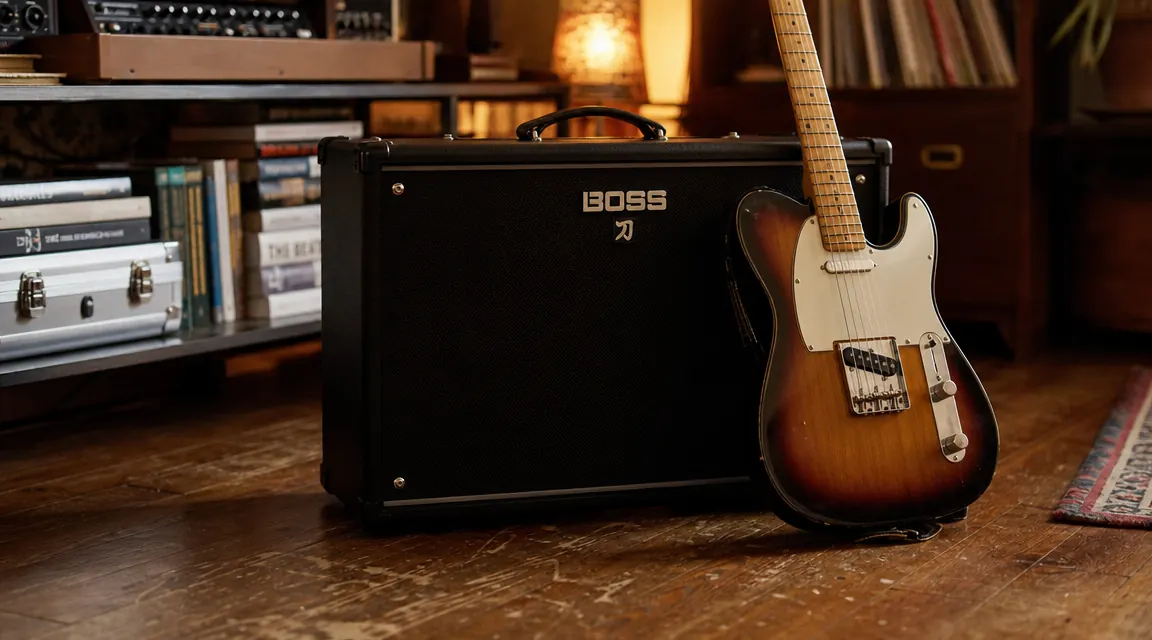
I'll be honest with you. When my buddy Dave first told me to try the Boss Katana MkII-50, I gave him the look. I own a tweed Deluxe clone, a Plexi-style head through a 2x12 with Celestion Greenbacks, and a late-1990s AC30. I am not the target customer for a digital modeling combo. But my wife and I moved into a smaller place in November, and the Plexi stack at gig volume was suddenly a relationship-ending proposition. So I picked up the Katana MkII-50 on a Saturday in December and told myself I'd give it a fair three months. Six months later it is still plugged in, and I am still playing through it almost every day.
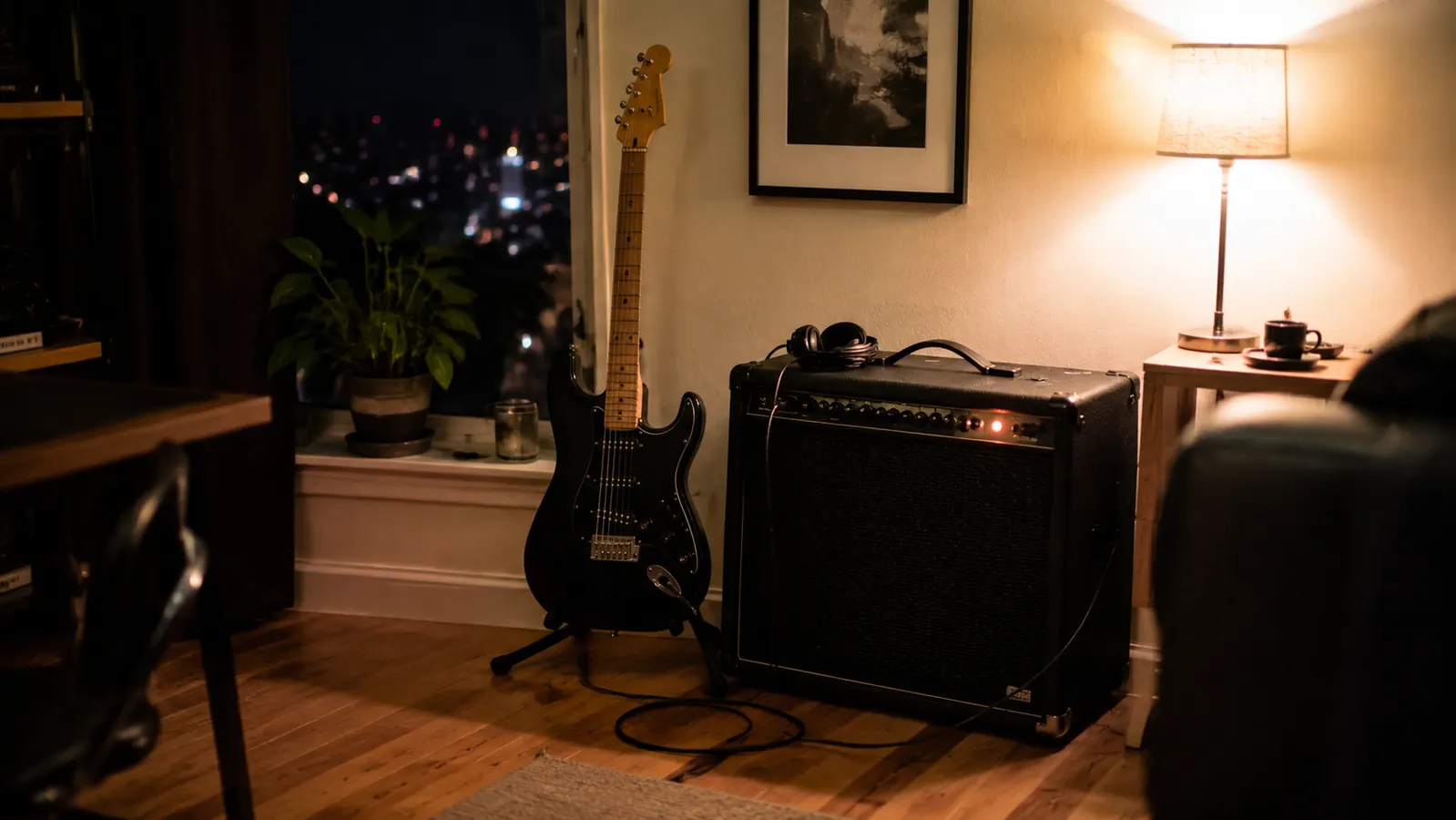
The Boss Katana MkII-50 is a 50-watt modeling combo with a 12-inch speaker, five selectable amp characters, a full effects suite built in, and a power attenuator that drops it to 25 watts, 0.5 watts, or completely silent through headphones. It has 4.7 stars across 2,107 Amazon reviews, which is almost suspiciously good for any piece of gear with that much range. This is my long-term take after six months of daily playing, a handful of small open-jam nights, and a lot of home recording through the USB output.
The Quick Verdict
A remarkably versatile modeling amp that sounds good at bedroom volumes and holds up at small-venue levels. The software learning curve is real, but the on-board tones alone are worth the price of entry.
Amazon Check Today's Price →Still wondering if it's worth the shelf space? Check today's price and see what other long-term owners are saying.
The Katana MkII-50 regularly ranks as the top-selling combo amp under $400 on Amazon. Current availability and pricing can shift, especially around holidays.
Amazon Check Today's Price on Amazon →How I've Used It Over Six Months
My setup is a 1969 Gibson SG Standard and, when I want cleaner single-coil territory, a mid-1990s American Strat. I play mostly classic rock, hard blues, and some Southern rock. I am not a metal guy and I am not an ambient-noodler. I need an amp that does crunchy clean, thick overdrive, and solid lead boost, and that does all three convincingly enough that I am not constantly apologizing to my ears.
The first three months were bedroom-only. I played through the Katana every day, usually an hour in the evening, sometimes longer on weekends. I used the onboard tones exclusively for the first six weeks before I downloaded the Tone Studio software and started digging into the deeper parameters. In months four and five I brought it to two open-jam nights at a small bar, running it at 50 watts through the 12-inch speaker with no PA support. Month six I started running it into my interface via the line out for direct recording tracks. That is the full range of conditions I am reporting from.
I also ran it with a handful of pedals in front, specifically a Boss SD-1 for extra push, a tuner, and occasionally a MXR Phase 90. The effects loop is clean and quiet, so outboard gear plays nicely with the onboard stuff without phase nightmares.
The Five Amp Characters: Which Ones Are Actually Useful
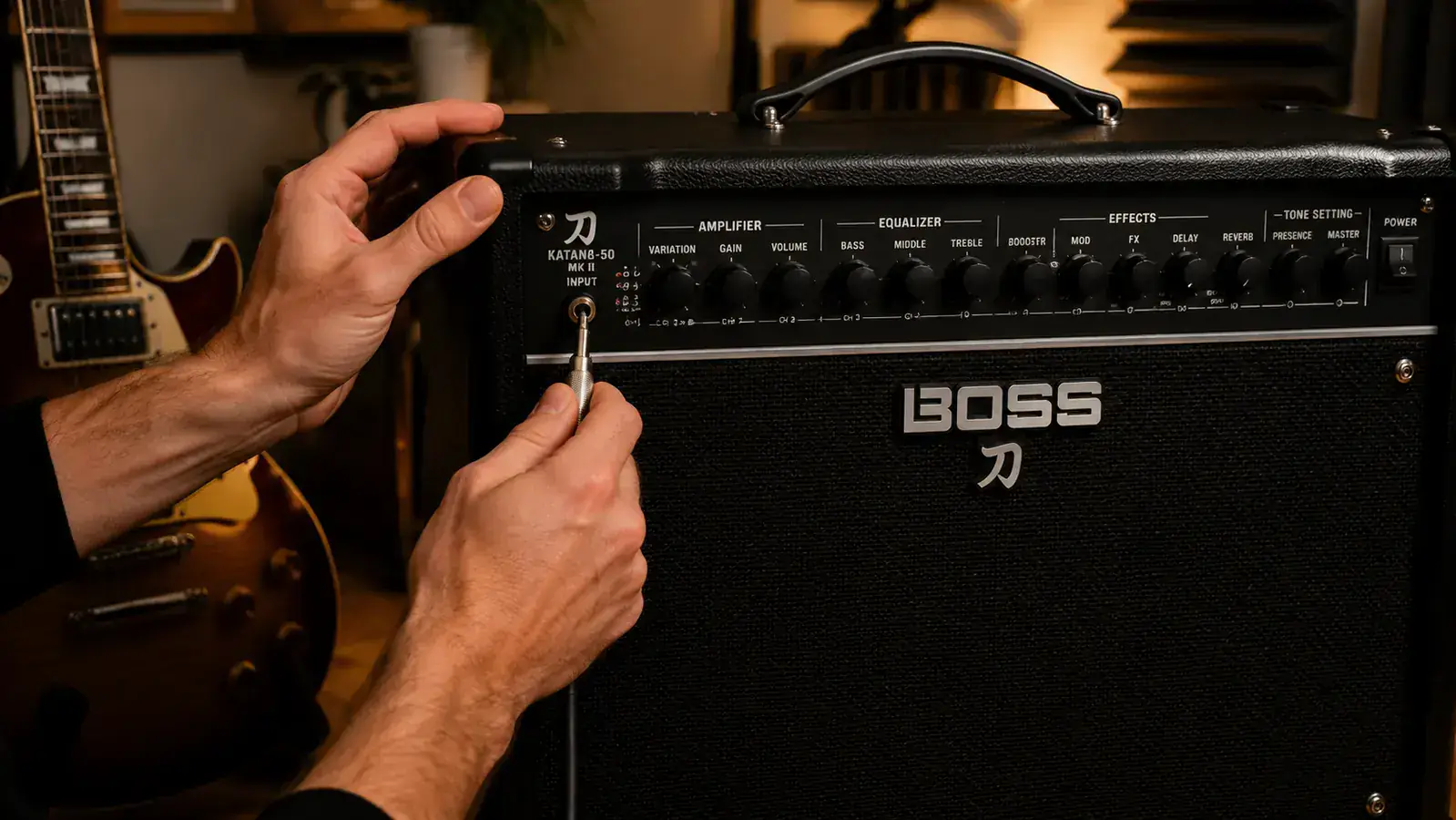
The Katana MkII-50 gives you five amp channels: Clean, Crunch, Lead, Brown, and Acoustic. I'll tell you right now that I use three of them regularly and the other two rarely. Clean is excellent. It has a slight sparkle that reminds me of a Fender-voiced circuit, not identical, but in the same neighborhood. Run a Strat into Clean with a little reverb and some of the onboard chorus and it genuinely sounds like a real amp, not a processed facsimile. That surprised me more than anything.
Crunch is where I live most of the time. Set around noon to one o'clock on the gain knob, with the bass cut slightly and the presence bumped up a tick, you get a very convincing mid-gain crunch that works for everything from Free to early AC/DC. The Brown channel is a high-gain British voicing that gets chaotic if you push it past about three-quarters gain, but at moderate settings it has a tight, compressed quality that feels good under fast single-note lines. Lead is a bit scooped for my taste out of the box, but the parametric EQ controls in Tone Studio fix that quickly.
Acoustic mode I have used exactly twice. It is fine. If you have a piezo-equipped acoustic-electric and need a clean, flat-ish reproduction of its sound, it will do that. It is not something I would buy the amp for.
The Power Attenuator: The Feature That Actually Matters
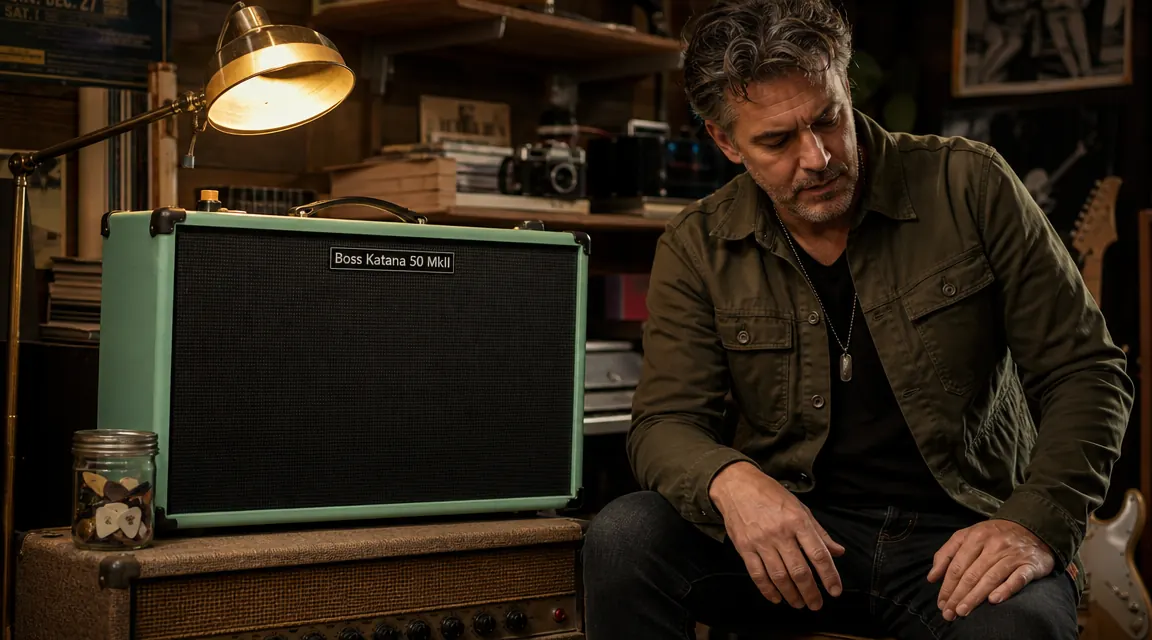
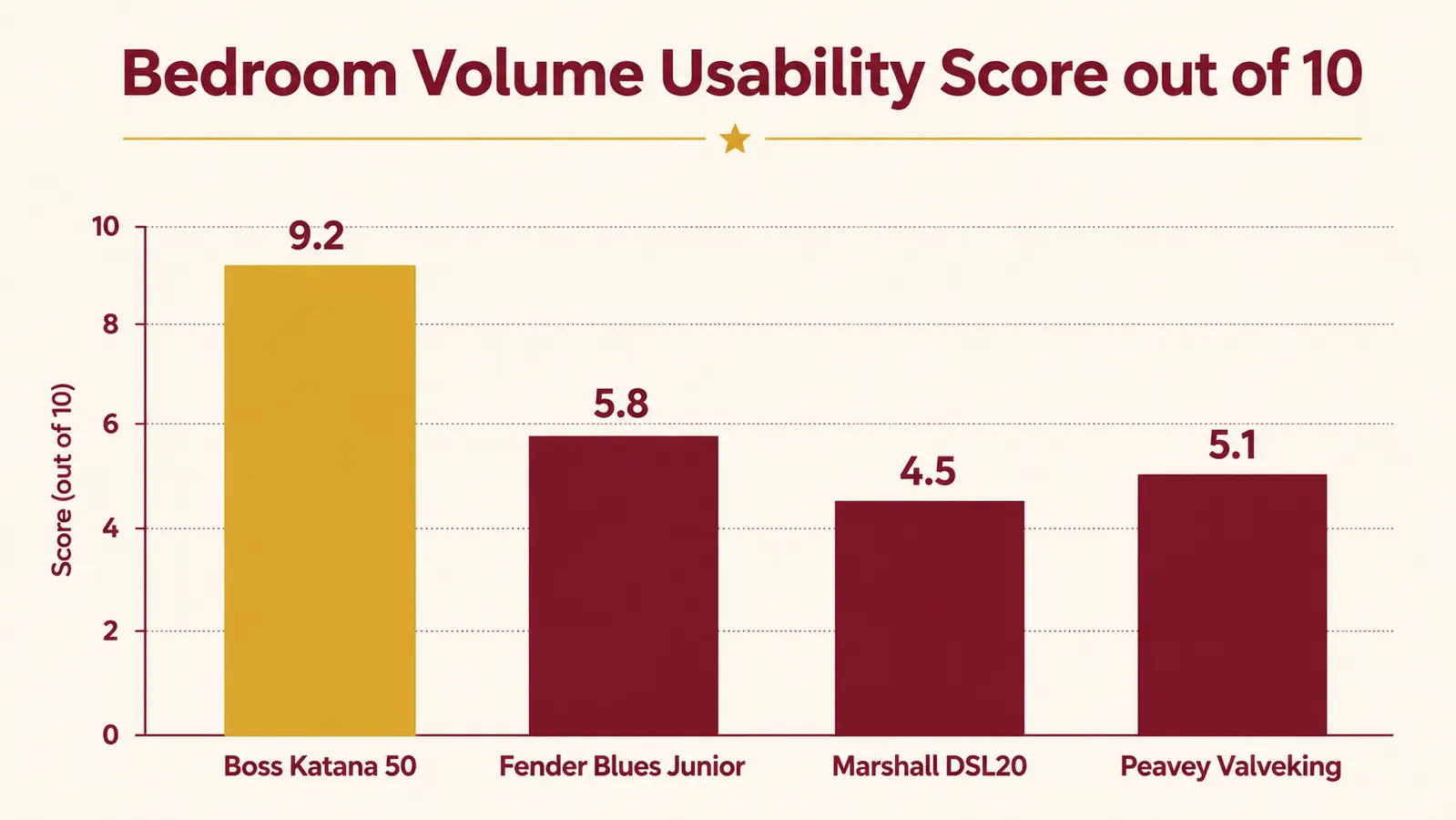
The reason most people end up buying this amp is not the amp characters or the effects. It is the power attenuator. Three settings: 50 watts, 25 watts, and 0.5 watts. That 0.5-watt setting is the real one. At 0.5 watts, this amp produces the kind of volume that lets you play classic rock crunch at eleven at night without rattling drywall. The tone compresses slightly compared to the 50-watt setting, but not as much as you'd expect. The speaker is still moving, which matters for feel. Headphone output is there too if even 0.5 watts is too loud, but I find 0.5 watts through the 12-inch speaker is my nightly default.
At 25 watts, the amp starts to breathe and the speaker distortion adds a small amount of natural saturation that you simply do not get at lower power. At 50 watts it is a legitimate small-venue amp. I had no problem being heard over a drummer at one of the jam nights without PA support, though I kept the master around nine o'clock. If you push it past that in a live setting you will get complaints from the sound person about bleed, but at sensible levels it projects well.
At 0.5 watts this thing produces classic rock crunch at eleven at night without rattling drywall. That one feature is worth the price of admission for anyone in an apartment or a house with thin walls.
Tone Studio Software: Necessary But Not Intuitive
Here is the honest part. The onboard controls get you about 70 percent of the way there. The remaining 30 percent lives inside the Tone Studio application, a free piece of software you download from Boss, connect via USB, and use to access parameters that are not exposed on the physical panel. Things like speaker cabinet simulation tweaks, gate threshold, parametric EQ, and deeper effects chain routing all live in Tone Studio. It is not hard to use once you understand the architecture, but the UI feels like it was designed in 2009 and has not been touched since. It works fine on a Mac. A few Windows users in forums report driver headaches.
The bigger learning curve is understanding how the three memory presets on the front panel relate to the deeper bank of presets in Tone Studio. You have three banks accessible without a computer, mapped to the three memory buttons. If you want to store more presets and scroll through them, you need a MIDI controller or to swap presets via the software. For a bedroom player who just wants to dial in three good tones and leave them there, this is no problem at all. For a gigging player who wants six different saved tones, it requires either a MIDI switcher or a bit of compromise. I landed on three tones: my clean, my crunch, and my lead boost. That covers about ninety percent of what I play.
Recording Through the USB and Line Out
The USB audio output is a legitimate recording tool. You get a cabinet-simulated signal that sounds like a mic'd speaker when fed into a DAW. I ran mine through GarageBand for some quick home demos and the tracks passed the wife test, meaning she did not immediately recognize them as laptop recordings. The cabinet simulation is slightly darker than I prefer, but the Tone Studio cab sim settings let you adjust it toward a brighter, more open-back character if needed.
The line out with cab sim off is also available if you want to run into a real cab IR in your DAW. I tried this with a third-party Greenback IR and it worked well, though at that point you are adding complexity that sort of defeats the simplicity argument for this amp. For quick home recording without a separate interface, the built-in USB audio is genuinely good.
What Held Up and What Did Not After Six Months
The amp itself has been completely reliable. No crackling pots, no intermittent signal, no speaker issues. It runs cool. The power button is a touch-capacitive switch rather than a physical toggle, which I initially found annoying but have stopped noticing. The cabinet is MDF with a black vinyl wrap that shows every scratch, and I have picked up a few scuffs from loading it in and out of my car for the jam nights. It is not a road-warrior cabinet in the way a tweed or a Tolex wrap tends to hold up, but it is not worse than most plastic-front combos in this price range.
The effects quality is better than I expected but still clearly digital when you push the reverb or delay into the longer settings. Modulation effects are genuinely usable: the chorus and flanger have a warmth that does not immediately read as cheap. Reverb is fine at short room-size settings, starts to get glassy at larger hall settings. Delay is useful, nothing special. I mostly use the onboard reverb sparingly and reach for my own pedals for more interesting time-based sounds.
What I Liked
- Three-level power attenuator lets you get real speaker-driven tone at bedroom volumes, 0.5W is the killer feature
- Clean channel is genuinely good, sparkly and touch-sensitive without being brittle
- Crunch channel covers classic rock, blues rock, and moderate hard rock convincingly
- USB audio output works as a proper recording tool with no extra interface required
- Built-in effects are comprehensive and the effects loop plays nicely with pedals
- At 4.7 stars across 2,100-plus reviews, the reliability track record is hard to argue with
Where It Falls Short
- Tone Studio software is functional but dated; the UI will frustrate anyone used to modern plugin interfaces
- Only three on-panel memory presets limits live-use flexibility without a MIDI controller
- MDF cabinet picks up scuffs easily; not ideal for regular loading in and out of a car
- Reverb sounds artificial at longer decay settings
- The Lead channel is scooped in the mids out of the box and needs Tone Studio adjustment to sound its best
- Speaker sounds polite at all volumes; if you are used to a real tube speaker breakup at volume, you will notice what is missing
Who This Is For
The Katana MkII-50 is genuinely ideal for three kinds of players. First, the apartment or townhouse player who needs real amp tone at considerate volumes. The 0.5-watt attenuator setting solves a problem that tube amp owners have been fighting for decades. Second, the player who gigs small bars or open jams occasionally but also practices at home a lot. This amp handles both without asking you to carry two different rigs. Third, the home-recording guitarist who wants USB direct recording without buying a separate interface and a cab IR pack. It does all three of those things competently without requiring you to become a software engineer. If you want to dig into the deeper parameters, the depth is there. If you just want to plug in and play, the default tones are good enough to stay there indefinitely.
Who Should Skip It
If you have a real tube amp situation that already works for your living arrangement, there is no urgent reason to switch. The Katana is excellent for what it is, but it does not replace the feeling of a good tube amp at the right volume. The speaker saturation, the sag, the way a tweed or a Plexi compresses dynamically under your pick attack, none of that is fully here. If you play exclusively at gig volume in a rehearsal space with no volume constraints and a real tube amp is already handling your sound, the Katana will feel like a step sideways rather than a step forward. It is also not the right choice for anyone who wants to get deep into amp sim territory and build complex multi-effect rigs. For that, a dedicated modeling platform like the Quad Cortex or Helix gives you far more flexibility for the serious investment.
Also worth noting: if you are comparing this amp to the Fender Mustang GTX50, that is a legitimate conversation worth having. My full breakdown is in the Boss Katana 50 vs Fender Mustang GTX50 comparison, but the short version is that the Mustang has more app-based preset options and a stronger clean platform, while the Katana wins on feel and the physical-control experience. And if you are skeptical of modeling amps in general, the 10 reasons the Katana beats a tube combo for bedroom players piece might reframe the argument.
If the 0.5-watt attenuator and the USB recording output solve real problems you have right now, the Katana MkII-50 is the amp.
It has held up for six months of daily use without a single issue. Check the current price on Amazon and read what other long-term owners are saying in the reviews.
Amazon Check Today's Price on Amazon →