
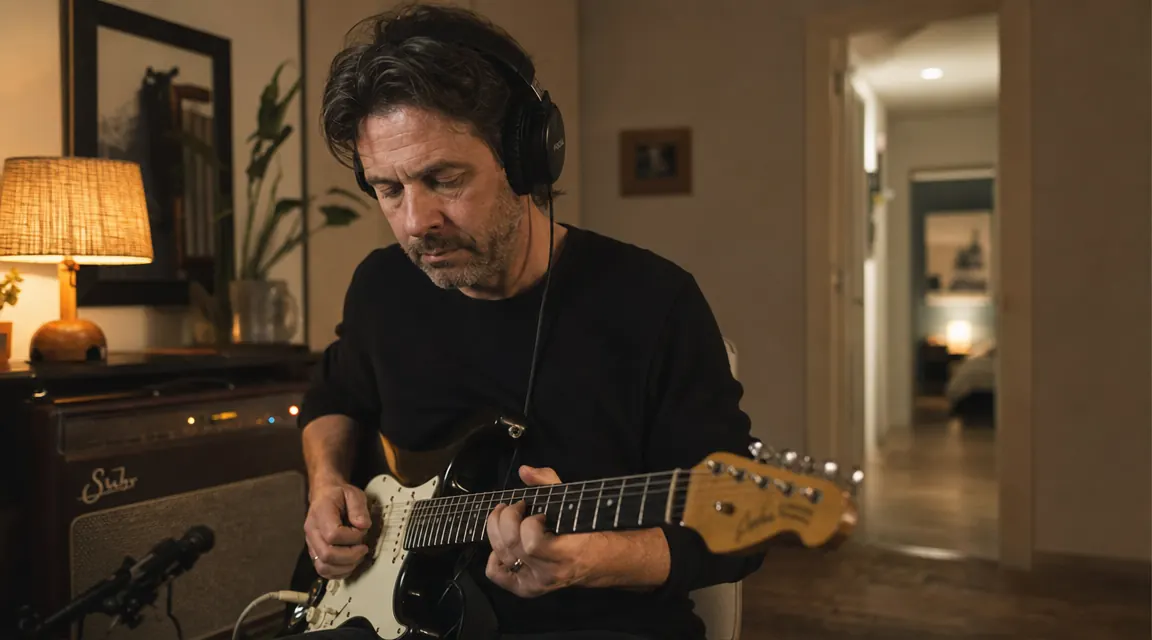
Let me tell you what happened the first time I mixed a guitar track on a pair of ATH-M50x headphones. I had my Strat running into a Focusrite Scarlett, the M50x on my ears, and I dialed in what I was absolutely convinced was a fat, warm, present rhythm sound. Bounced it, played it back through my studio monitors, and it was thin as paper. Too much high-mid bite, not enough body, and the bass that sounded so satisfying through the headphones was doing nothing for the actual guitar tone. That is the M50x experience in one story. These headphones sound great. They just don't always tell you the truth.
The ATH-M50x has over 33,000 Amazon reviews and a 4.7-star average. It is recommended in virtually every "best studio headphones under $200" list on the internet. I am not here to tell you those people are wrong. I am here to tell you that most of them are reviewing the M50x as a listening headphone, not as a monitoring tool for guitarists who need to hear what their mixes actually sound like. That is a different job, and the M50x does it differently than the reviews suggest.
The Quick Verdict
A genuinely good closed-back headphone that flatters almost everything it plays, which makes it excellent for enjoyment and problematic for mixing guitar tracks where you need the truth.
Amazon Check Today's Price →If you want a headphone that sounds great for guitar practice and late-night playing, the M50x earns its reputation
Over 33,000 buyers agree it is among the best closed-back headphones at this price point. Check today's price on Amazon before it moves.
Amazon Check Today's Price on Amazon →How I've Used It (And What That Test Revealed)
I have had the M50x in my signal chain for years in different configurations. I have run them off a Focusrite Scarlett 2i2 for silent guitar practice. I have plugged them into a Kemper for headphone-out monitoring. I have used them to check rough mixes before committing to a printed track. And I have used them the way most people use them: plugged into a phone or a laptop while listening to records to study guitar tones. All four contexts tell you something different about what this headphone is.
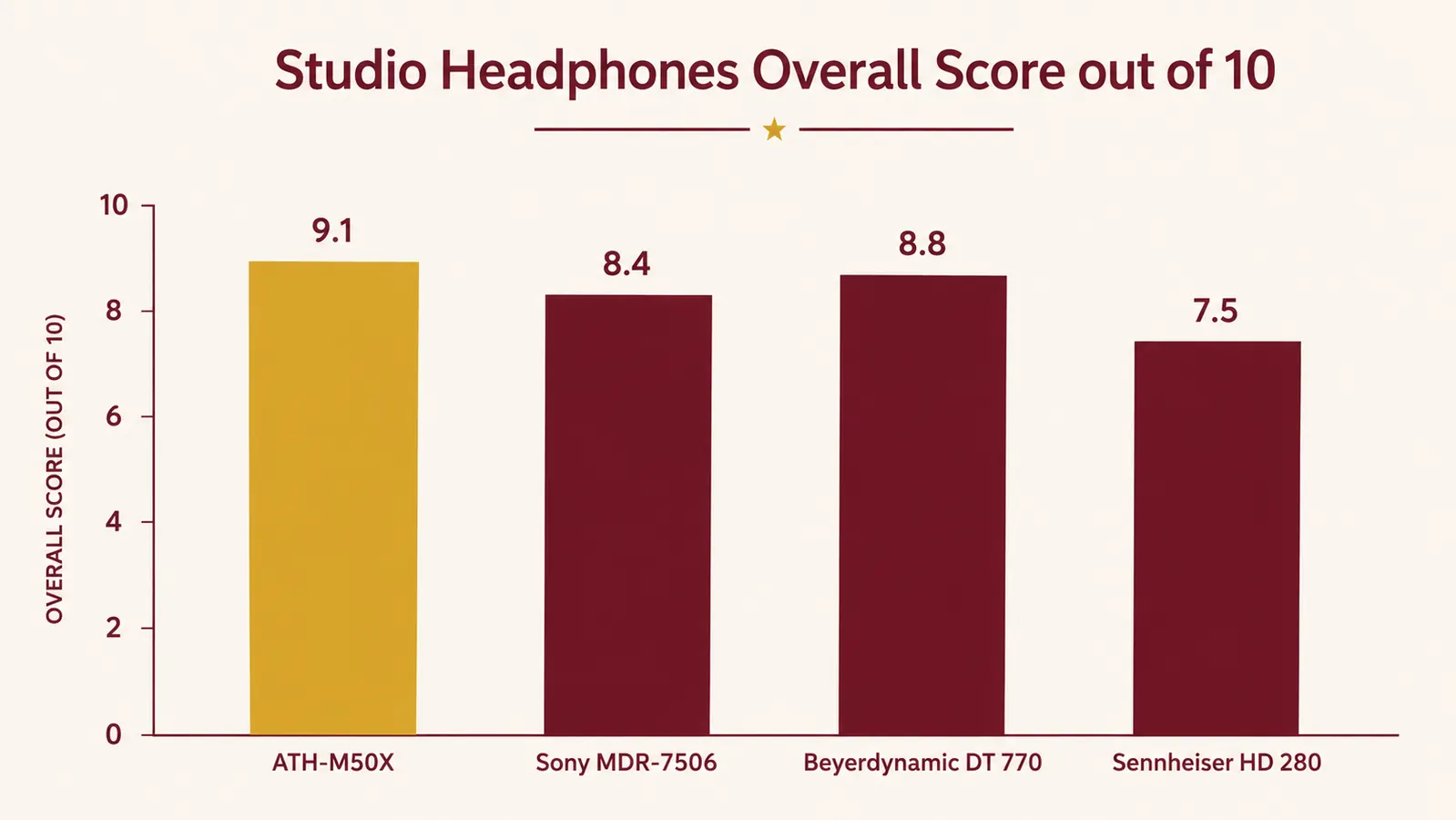
My main test rig is a Tele through a Strymon Iridium into the Scarlett, with a DAW patch running compression and a touch of reverb. I ran that same chain through the M50x, through a pair of Sony MDR-7506s, and through a pair of Sennheiser HD 600 open-backs. The differences were not subtle. The M50x had the most pleasant, full sound of the three. It also had the least accurate representation of what the mix actually contained.
That is not a knock. It is a description of what the headphone is tuned to do. Understanding the tuning is the whole game.
The V-Shape: What It Is, and Why It Fools Guitar Players Specifically
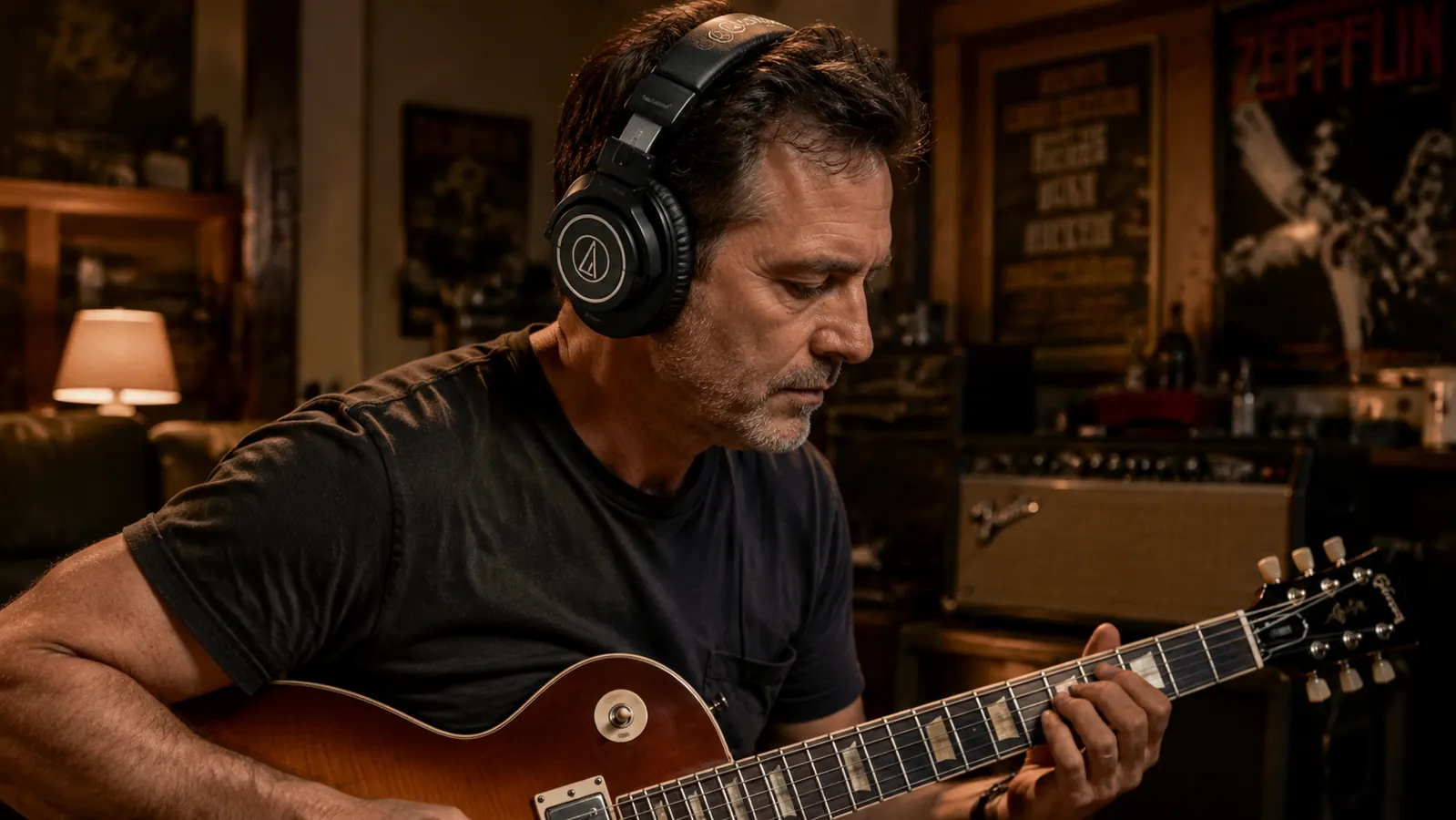
The M50x has a V-shaped frequency response. Bass and treble are both elevated relative to the midrange. Audio engineers describe this as a "fun" or "consumer-friendly" tuning because it makes virtually every kind of music sound exciting and full. Bass hits harder. Cymbals shimmer. Guitars sound present and sparkly in the top end.
The problem for guitarists is specific to how electric guitar actually sits in a mix. Guitar tone lives mostly between 200Hz and 5kHz. That is exactly the middle of the frequency spectrum, which is exactly where the M50x pulls back relative to flat. So when you are dialing in a guitar tone through these headphones, you are hearing a version of your guitar that is slightly scooped in the region where guitar tone actually lives. You compensate by cutting bass and boosting mids to get it "sounding right" in your ears. Then you pull the headphones off and your guitar sounds like a wasp in a tin can through the monitors.
The fix is to learn the headphone. After enough hours with the M50x, you calibrate to its coloration the same way you calibrate to a mixing room that has a bass buildup in one corner. You learn to trust the mids even when they don't feel exciting, and you resist the urge to scoop them. Plenty of engineers mix on V-shaped headphones and do fine. But it takes time to build that calibration, and most people buying their first pair of studio headphones don't know they need to.
The M50x makes everything sound like a slightly better version of itself. That's wonderful when you're listening. It's dangerous when you're mixing.
The Upper-Mid Spike and What It Does to Vocals and Guitar Solos
The V-shape is the big conversation, but there's a second quirk that matters specifically for tracking and mixing: a noticeable rise in the upper midrange, somewhere in the 7-9kHz region. On a lot of headphones, that zone is relatively flat or gently rolled off. On the M50x, it adds a kind of crispness and "air" to the top end of voices and lead instruments.
For vocal monitoring while tracking, this can actually be nice. Singers often feel more confident when their voice sounds present and detailed. But for guitar solos and lead work, it can fool you into thinking your lead tone has more definition and cut than it actually does. You'll dial in a lead that sounds perfectly separated through the M50x, then discover it's swimming in the mix when played back through speakers. The upper-mid bump is doing extra work that your amp or your overdrive pedal isn't actually providing.
Again, not a fatal flaw. Plenty of excellent tracks have been cut and mixed by engineers working on the M50x. But if you are new to headphone monitoring and you are using these as your only reference, you want to know that the headphone is flattering your lead tones in a way that speakers won't.
The Bass Bump and Guitar Mixing: A Specific Warning
The low-end elevation on the M50x is the thing that catches guitarists most off guard. I have watched it happen to players in my studio more than once. They plug in, hear their amp or amp sim sounding huge and warm and full in the low end, and they dial back the bass EQ to compensate. The result through the monitors is a thin, weak sound with no bottom.
The M50x bass boost is most pronounced around 80-100Hz. That is exactly where the body of a guitar amp lives. It's also where a bass guitar and kick drum sit in a full band mix. So when you are checking whether your guitar track is clashing with the bass guitar or the kick, you are listening through a headphone that is artificially inflating all three of those elements simultaneously. You cannot hear the clashing because everything in that zone sounds big and round.
For silent practice, this bass lift is genuinely enjoyable. Your guitar through an amp sim sounds thick and satisfying in a way that budget earbuds or laptop speakers never do. But if you are doing any actual recording work where the guitar has to sit in a mix with other instruments, you need a second reference. The M50x should be one of two or three checks, not the only check.
Physical Comfort: The Head-Size Problem They Don't Warn You About
I wear a size 7 5/8 hat. Medium-large head. After about 90 minutes in the M50x, the clamping force on my temples becomes the main thing I'm thinking about. This is not uncommon. The M50x has relatively high clamping pressure straight out of the box, which is good for isolation (it seals well even in moderately noisy environments) but rough on extended sessions.
The pads themselves are decent quality, but they do compress over time. After heavy use, they flatten out and the clamping pressure that was already firm becomes more noticeable because your ears are now closer to the hard plastic driver housing. Replacement pads are available from Audio-Technica and from third parties, and the M50x's detachable cable design means the cable is not your failure point. But the pads do wear, and once they flatten, comfort drops noticeably.
Players with larger heads or those prone to headphone fatigue should know this going in. The M40x, the M50x's cheaper sibling, actually has slightly more forgiving clamping pressure and pads that some people find more comfortable for long sessions, even though the M50x has the more premium reputation. Worth comparing them before committing.
The Cable Situation: Detachable Is Good, But There Are Quirks
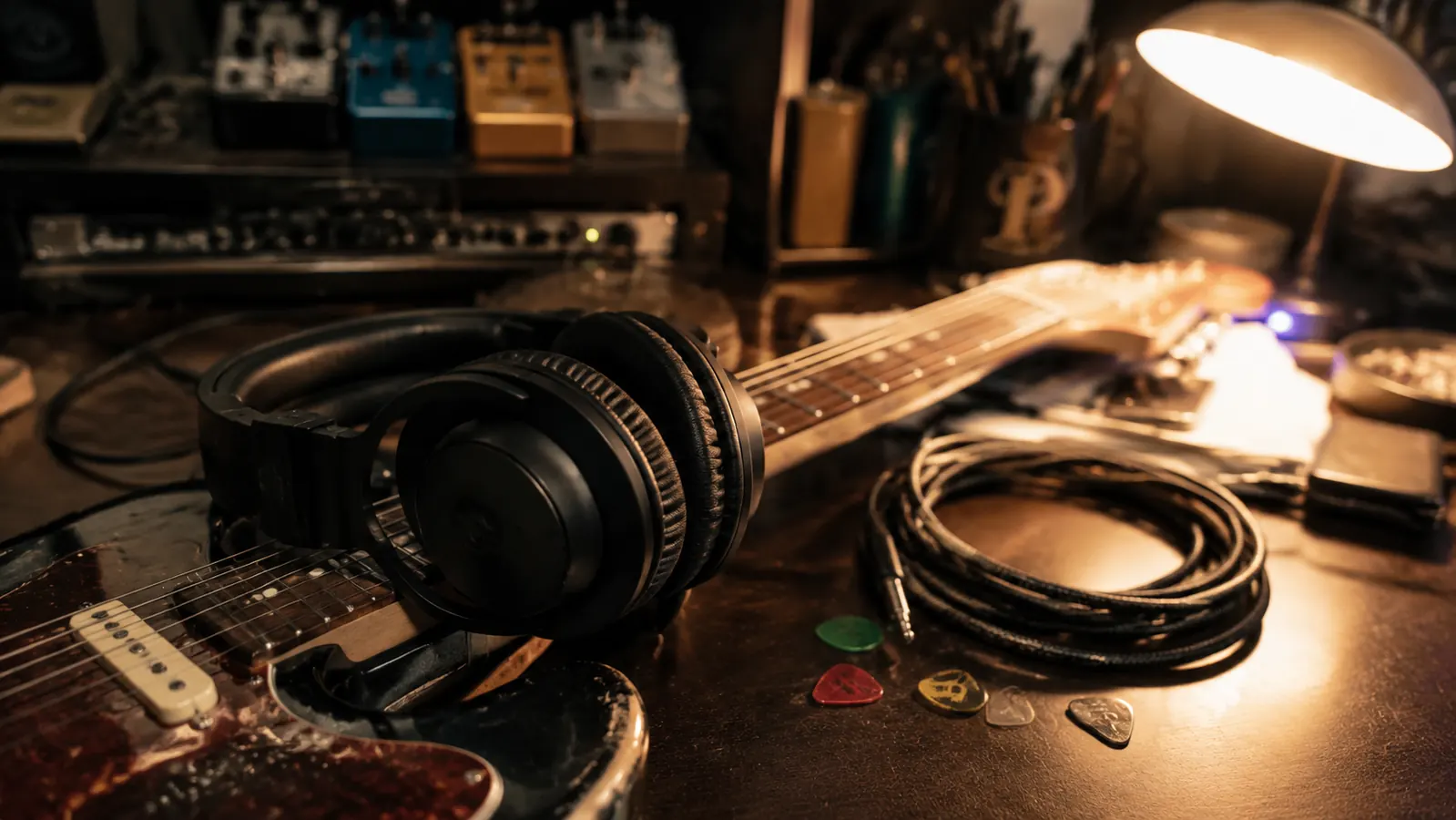
The M50x uses a 2.5mm locking detachable cable, which is a genuine improvement over the permanently attached cable on the original ATH-M50. The detachable design means a frayed or broken cable doesn't kill the headphone. You replace the cable for a few dollars, not the entire unit.
The quirk is the locking collar. It is a proprietary Audio-Technica design, which means you cannot just plug in any 2.5mm cable. You need cables that either use the same locking collar or that are thin enough at the connector end to seat properly. Generic 2.5mm cables often don't fit because the connector barrel is too wide. Audio-Technica sells replacement cables in straight and coiled varieties, and there are a handful of third-party vendors who have reverse-engineered the collar. But if you buy the M50x expecting to swap in a random cable from your parts bin, you will be annoyed to discover you can't.
The three included cables (straight, coiled, and short with a 3.5mm termination) cover most use cases. The coiled cable is the one I use at the desk: it has enough give that you are not constantly pulling the headphone off your head when you lean back, but it does not drape all over your keyboard either. It is the right call for studio use.
When to Spring for the M70x or Go Open-Back Instead
The ATH-M70x costs about $100 more than the M50x. The frequency response is considerably flatter, with less of the bass and treble elevation that defines the M50x's sound. If you are doing serious mixing work and you want a closed-back headphone that gives you a more honest picture, the M70x is the better tool. You give up some of the low-end warmth that makes the M50x satisfying for casual listening, but you gain a reference that is less likely to mislead you during a mix session.
If isolation is not a priority, open-back headphones are worth a serious look. I have mixed on Sennheiser HD 600s and AKG K702s, and the difference in stereo imaging and mix clarity compared to closed-backs is not subtle. Open-backs breathe in a way that closed-backs cannot, and that translates to a more accurate sense of how instruments sit in a mix. The tradeoff is bleed. If you are tracking in the same room as a microphone, open-backs leak sound and you will get bleed on the recording. For silent guitar practice via headphone-out, that's a non-issue.
For most guitarists doing silent practice at home, the M50x is the right call and the M70x or open-backs are overkill. For home studio players who are actually trying to produce finished tracks, the M70x or a pair of entry-level open-backs should at least be on your list. The M50x makes a fine secondary reference in that case, but you want something flatter as your primary.
What I Liked
- Genuinely full, satisfying sound for guitar practice and late-night playing
- Excellent isolation for quiet environments or noisy households
- Detachable cable design extends the life of the headphone significantly
- 45mm drivers with wide frequency range handle the full spectrum of guitar tones cleanly
- Folds flat for storage, robust build quality, has survived years of daily use in Marko's studio
Where It Falls Short
- V-shaped frequency response can mislead you when mixing guitar tracks
- Upper-mid lift flatters lead tones in a way that doesn't translate to speakers
- Clamping pressure becomes uncomfortable for players with larger heads after 60-90 minutes
- Pads compress and flatten over time, worsening comfort on long sessions
- Proprietary 2.5mm locking connector limits cable swapping options
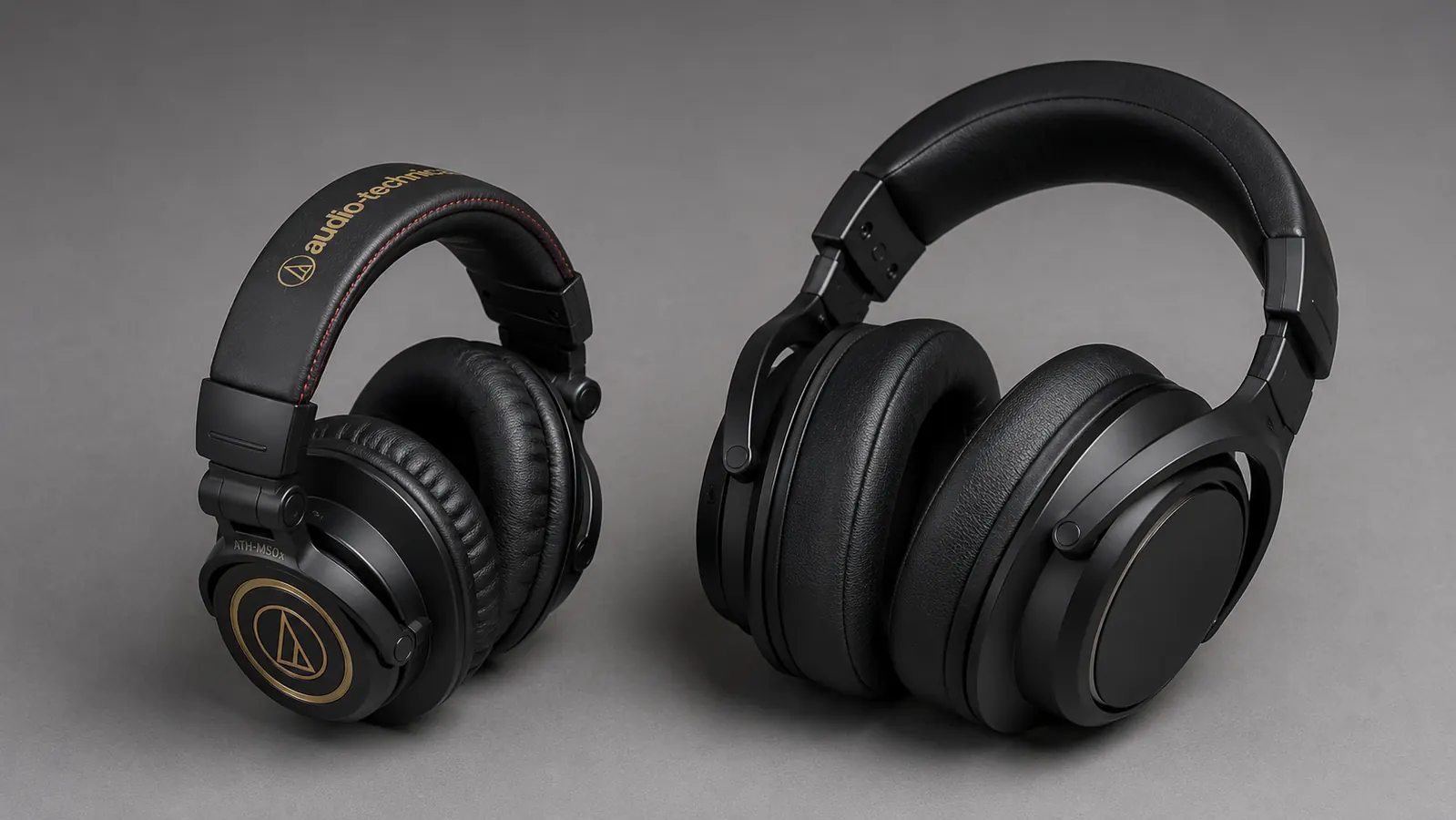
Who This Is For
The M50x is the right headphone for guitarists who want to practice silently through an interface or amp sim and sound good doing it. It is excellent for anyone monitoring through a headphone-out on an amp like the Boss Katana where the dedicated headphone circuit is doing its own cab simulation. It is fine for checking rough mixes as one reference among several. And it is a very good headphone for just listening to records, which you should be doing anyway if you want to learn how real guitar tones are constructed.
Who Should Skip It
If your primary use is mixing finished tracks and the M50x would be your only reference, you will probably make decisions you regret. The V-curve is real, and it takes discipline to work around it. Players with larger heads or jaw problems who already get tension headaches from headphone use should try these on before committing, or at least budget for an early pad replacement. And if you are spending $160 and you do not actually need closed-back isolation, a pair of open-backs in the same price range will give you a more honest mix picture. The M50x earns its reputation for most buyers. Just make sure you are one of them before you click the button.
Still the best-sounding closed-back under $200 for guitar practice, as long as you go in knowing what it does
The ATH-M50x has held the top spot in this price range for years because it genuinely delivers. Check today's price and see if the M50x is available with the coiled cable bundle.
Amazon Check Today's Price on Amazon →