
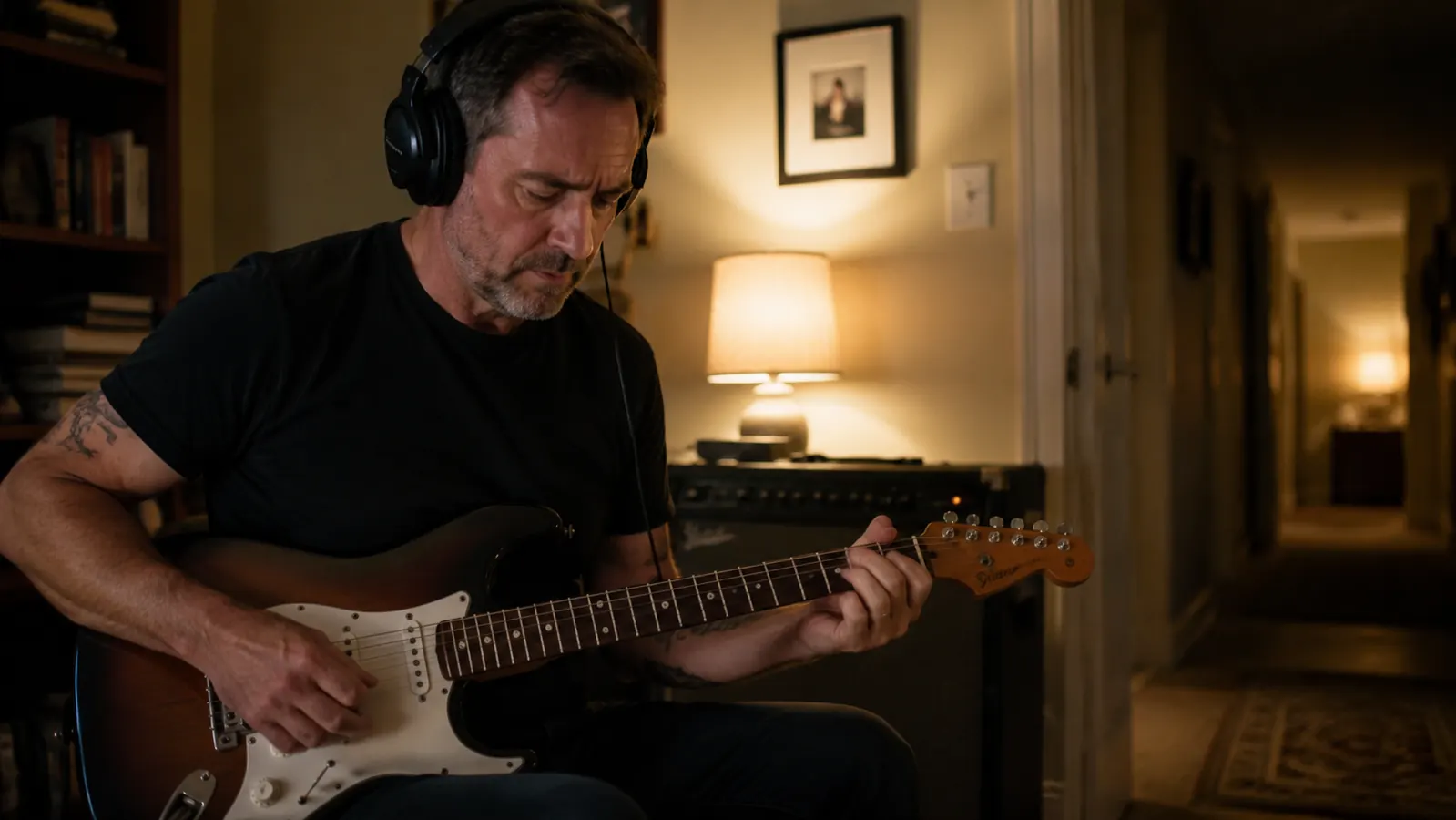
I'll be straight with you. When I first bought the Audio-Technica ATH-M50x, I wasn't thinking about guitar practice at all. I picked them up for mixing duties in my home studio, the same reason every engineer buys them. But somewhere around month three, I realized I was reaching for them every time I wanted to run through a song at midnight without waking up my wife or the neighbors. Three years later they're still the headphones I recommend to every guitarist who asks me about silent practice, and there are ten specific reasons why.
These aren't gaming headphones with boosted bass that flatters everything you play. They're not Bluetooth cans with a 300ms lag that makes playing feel like you're drunk. They're honest studio monitors in headphone form, and that honesty is exactly what makes them so useful when you're trying to get better at guitar.
Stop playing through headphones that lie to you about your tone.
The ATH-M50x gives you the same honest, flat-ish response that engineers trust for mixing. At current price it's one of the best value decisions in any home studio.
Amazon Check Today's Price on Amazon →Closed-Back Design Kills Bleed, Not Your Tone
The ATH-M50x uses a circumaural closed-back design with 45mm drivers. That closed back means the sound coming out of your amp sim or interface stays in your ears, not bleeding into a condenser mic across the room. More importantly, the isolation cuts enough ambient noise that you actually hear your playing at a volume that's safe for your ears. I run mine at about 60 percent and I can hear every string buzz and fret thud I'd normally mask with room volume. That's humbling, and also extremely useful.

The Frequency Response Doesn't Flatter Your Bad Days
Consumer headphones are tuned to make everything sound bigger and more exciting than it is. The ATH-M50x isn't flat in the true reference-monitor sense, there's a mild low-mid emphasis and a bit of presence around 8-10kHz, but it's honest enough that when your tone sounds muddy through these, your tone is actually muddy. That feedback loop trains your ear faster than any amount of playing through a hyped consumer can. I've dialed in more useful amp settings by ear through the M50x than I ever did through my old gaming headphones.
They Handle High-Gain Without Distorting the Drivers
When you're running a high-gain amp sim through headphones, cheap drivers give you fizz on top of fizz. The ATH-M50x's 45mm large-aperture drivers can handle transient-heavy, harmonically complex signals without breaking up. I've run ENGL and Mesa sim patches through these at fairly high monitoring levels and they stay composed. The top end stays crisp, the low mids don't turn into a wall of mud. That matters a lot when you're trying to hear whether your pick attack is clean or clipped.
The Detachable Cable Is a Bigger Deal Than It Sounds
Every other pair of headphones I've destroyed for music use met its end because the cable connection failed. The ATH-M50x ships with a detachable cable, which means when you eventually yank them off your head mid-song and the cable snaps taut on something, you replace a $12 cable, not a $159 pair of headphones. You get three cables in the box: a short coiled one, a longer straight one, and a shorter straight one. I use the coiled cable for guitar work because it keeps the slack managed while I'm moving around.
Zero Bluetooth Latency Problems
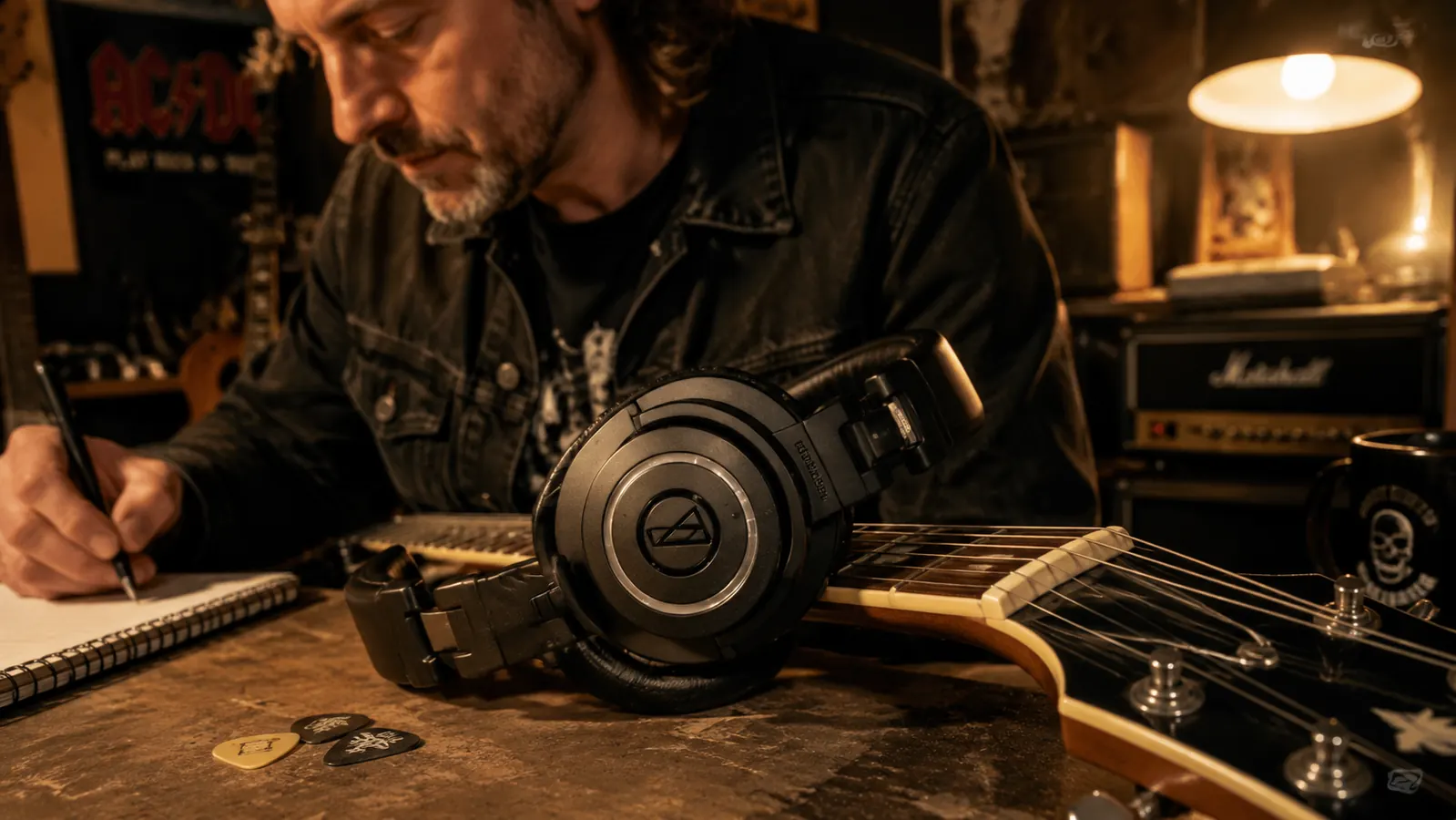
Latency is the silent killer of headphone guitar practice. Any Bluetooth headphone, regardless of what the marketing says, introduces at minimum 20-40ms of delay between your pick hitting the string and the processed sound hitting your ear. That's enough to completely wreck your timing sense and make you feel like you're playing through quicksand. The ATH-M50x is wired, full stop. Plug it into your interface or headphone amp and the signal is there in real time. Your timing stays accurate. Your technique actually improves.
Latency is the silent killer of headphone guitar practice. Any Bluetooth can, regardless of the marketing, introduces enough delay to wreck your timing sense. The ATH-M50x is wired, full stop.
Comfort Holds Up for Multi-Hour Practice Sessions
The ear pads on the ATH-M50x use a protein leather material over memory foam. They're not the most breathable thing on the planet, you will notice heat after about 90 minutes, but they clamp firmly without being painful and the headband distributes weight well. My old Audio-Technica ATH-M30x had ear pads that would have me pulling them off to rub my ears every 45 minutes. The M50x stays comfortable through a full two-hour practice session, which is long enough for any productive sit-down. Replacement pads are widely available and cheap if you need them after a couple of years.
Works With Any Interface, Headphone Amp, or Direct Out
The M50x runs at 38 ohms impedance, which means you don't need a dedicated headphone amp to drive them properly. Your audio interface's headphone out can push them fine. The Boss Katana's direct headphone jack drives them fine. Even a phone audio adapter technically drives them, though you'll want more gain than your phone can offer for guitar signals. The point is you're not locked into expensive upstream gear. Buy the headphones, plug them into whatever interface you already own, and they work.
They Double as Your Mixing Headphones
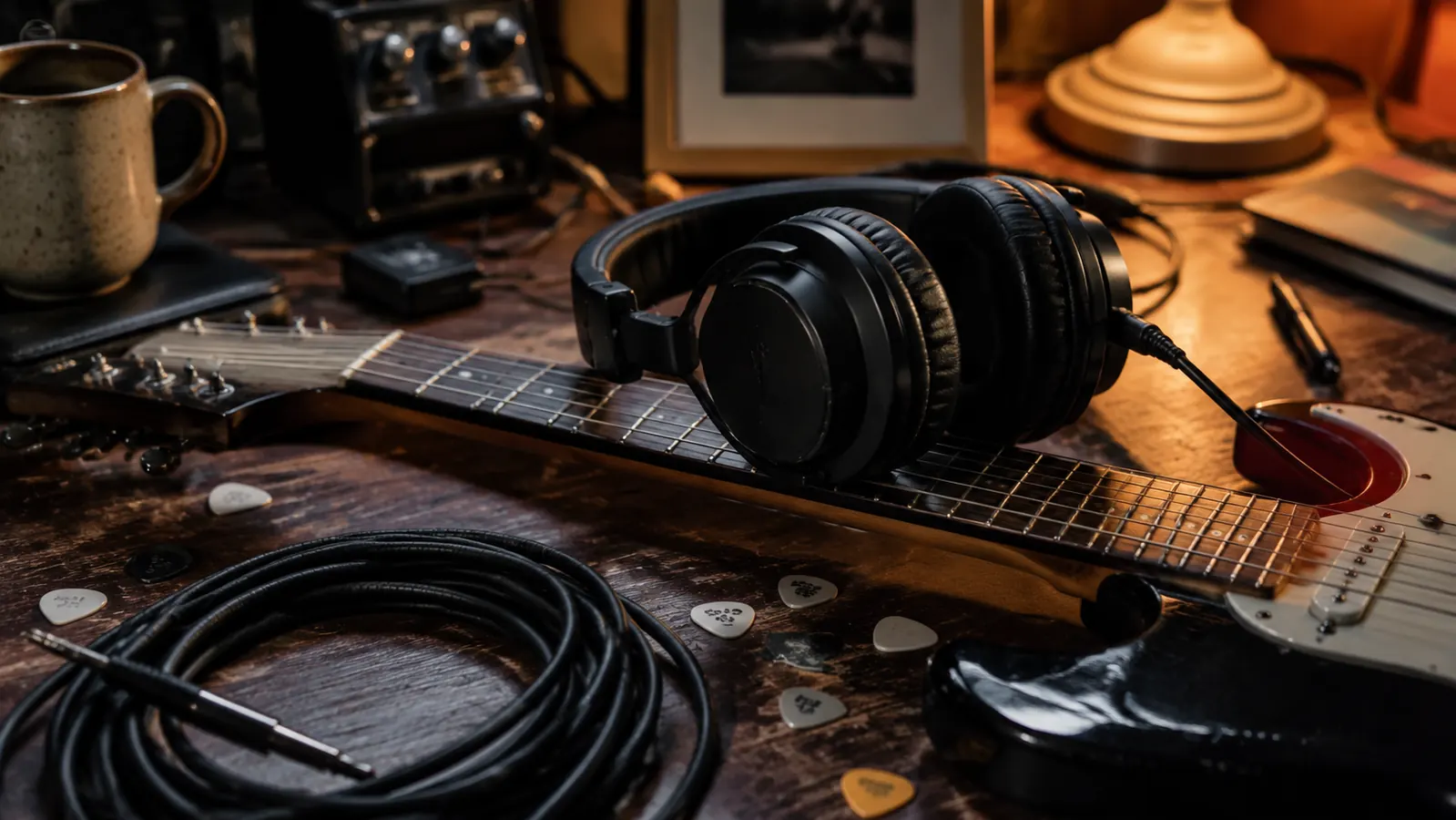
If you record even occasionally, the same headphones you use for silent practice can now serve your mixing workflow. This matters because it builds familiarity with the sound signature over time. After a few months of regular use you know intuitively when something sounds right or wrong through the M50x. That's the same thing engineers mean when they talk about knowing their monitors. You're building the same reference through repetition. Two tools, one purchase, one set of muscle-memory associations.
33,000 Amazon Reviews Means Parts and Advice Are Everywhere
The ATH-M50x has been in production long enough to have a massive support ecosystem around it. Replacement ear pads, cable upgrades, headband cushions, dedicated online threads about driver matching for guitar use, firmware notes for the Bluetooth sibling versions. If something wears out or breaks, someone has already documented exactly how to fix it and where to source the part. That kind of community durability is something you can't manufacture with a new or niche product. You're buying into a proven, long-running platform.
The Price Point Makes Sense for What You're Actually Buying
At current price you're not buying fashion headphones with an audiophile markup. You're buying a tool that Audio-Technica has refined over many years and sold into actual professional studios. The M50x sits in a category of its own: too good to dismiss as beginner gear, too affordable to feel precious about. You'll throw them on the desk, coil the cable a few hundred times, toss them in a bag, and they'll hold up. Buy cheap headphones and you'll replace them twice in the same timeframe and spend more money overall. Buy the M50x once and use them for years.
What I'd Skip
I wouldn't buy the ATH-M50xBT2, the Bluetooth version, for guitar work. The whole point of these for guitarists is zero latency, and the Bluetooth variant undermines that completely. The wireless convenience doesn't help you when you're plugged into an interface anyway. Stick with the standard wired M50x. I'd also skip the foam ear pad upgrade kits that try to make them 'studio reference flat.' The slightly enhanced low mids on the stock pads actually represent guitar frequencies in a way that feels natural. Leave the tuning alone.
Don't buy the Bluetooth version for guitar practice. The whole point is zero latency, and wireless defeats that instantly.
Late-night practice should never mean bad tone or neighbor complaints.
The ATH-M50x is the wired, studio-honest headphone that makes silent guitar practice actually worth doing. Check today's price and see if they're in stock.
Amazon Check Today's Price on Amazon →