
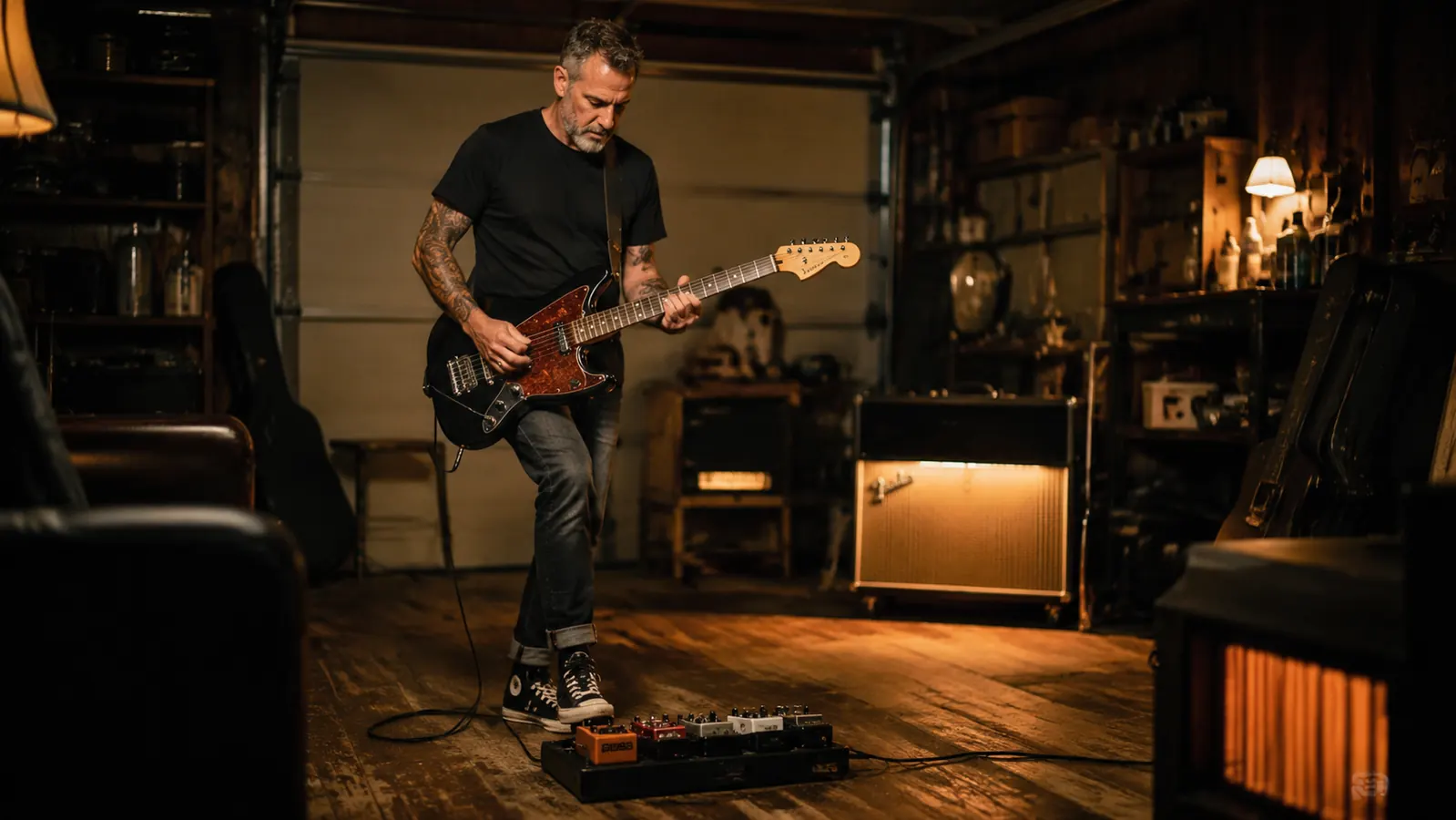
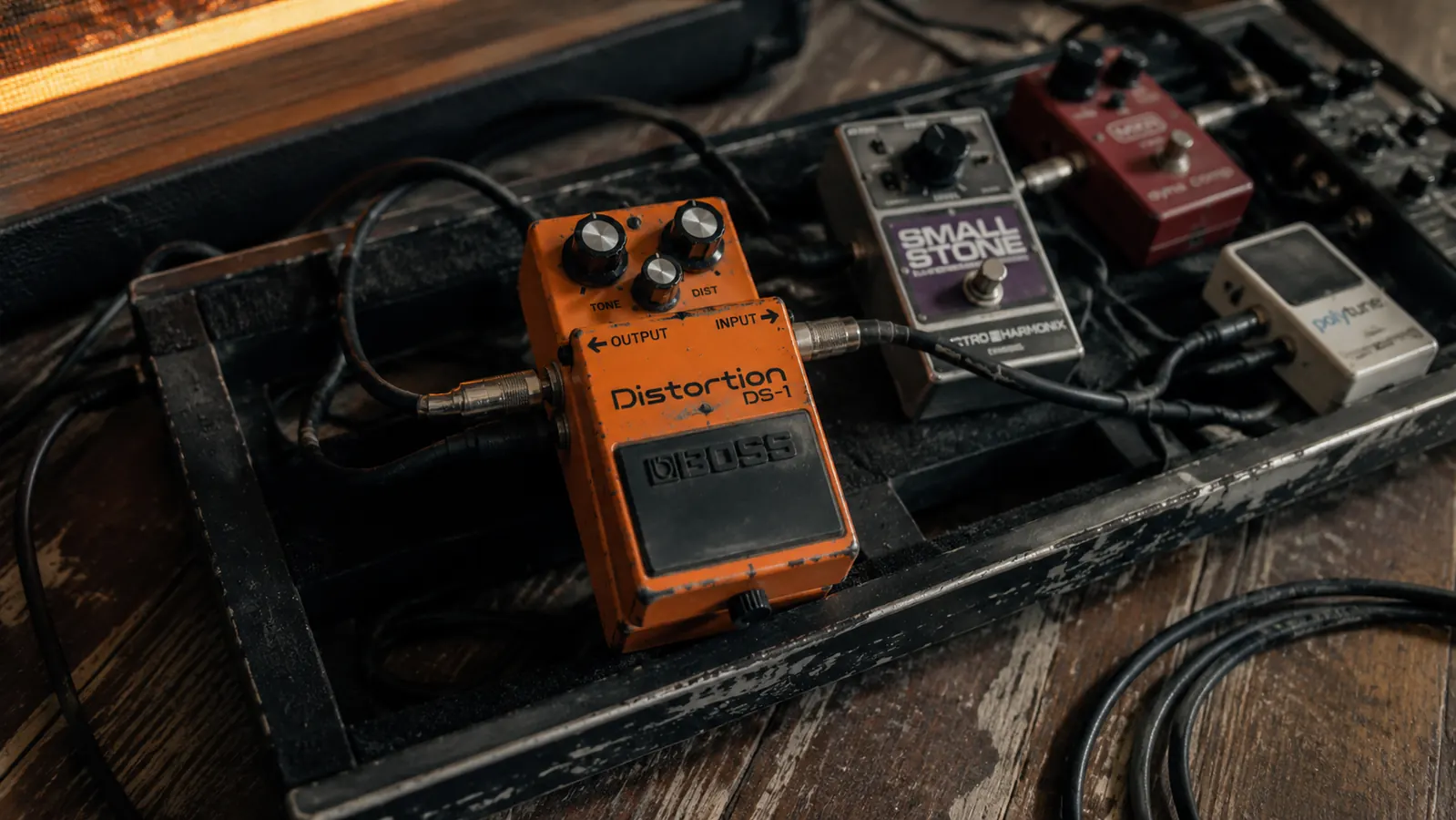
The Boss DS-1 has a reputation problem. People plug it in, crank the Dist knob to eleven, and get a fizzy, compressed wall of noise that sounds nothing like the Marshall-driven crunch on their favorite classic rock records. Then they blame the pedal. I have owned four of these things over thirty years of gigging, and I will tell you straight: the DS-1 is not the problem. The settings are.
The tones you want, AC/DC's Brown Sound stomp, the Stones' raw mid-grind, Page's warm woolly crunch on 'Whole Lotta Love,' those are not high-gain tones. They are medium-gain tones with the right amp platform underneath them, the right pickup talking into the pedal, and a picking hand doing some actual work. This guide covers every variable in that chain. Follow the steps in order, because each one builds on the last.
If you do not have a DS-1 yet, check today's price before we start.
The Boss DS-1 has stayed under $80 for decades. It is the starting point for every classic rock crunch conversation for a reason: it works when you set it correctly.
Amazon Check Today's Price on Amazon →Step 1: Set Your Amp as a Clean Platform
This is where most people skip ahead and pay for it later. Your amp channel should be clean or barely breaking up on its own before the DS-1 hits it. If you are running a hot amp channel plus a pedal's gain on top, you get mush. Specifically, you get fizz in the upper mids and a loss of note definition that makes chords sound like noise.
For a tube amp: set the volume where the amp just starts to breathe when you dig in hard with a clean input, but does not break up on its own at normal picking pressure. That is your sweet spot. For solid-state amps like the Boss Katana, use the Clean or Brown channel at its minimum drive setting. The Katana's 0.5-watt setting is actually very useful here because it lets you get a little speaker compression without deafening the room. Bass on your amp around 6, mids around 6 or 7, treble around 5. Presence at noon if you have it.
Do not set your amp's mids low. Every classic rock tone you are chasing is a mid-forward tone. Scooped mids is a metal thing. If you are trying to sound like Angus Young and you have the mids at 3, you are already wrong.
Step 2: Set the DS-1 Knobs for Classic Rock Gain
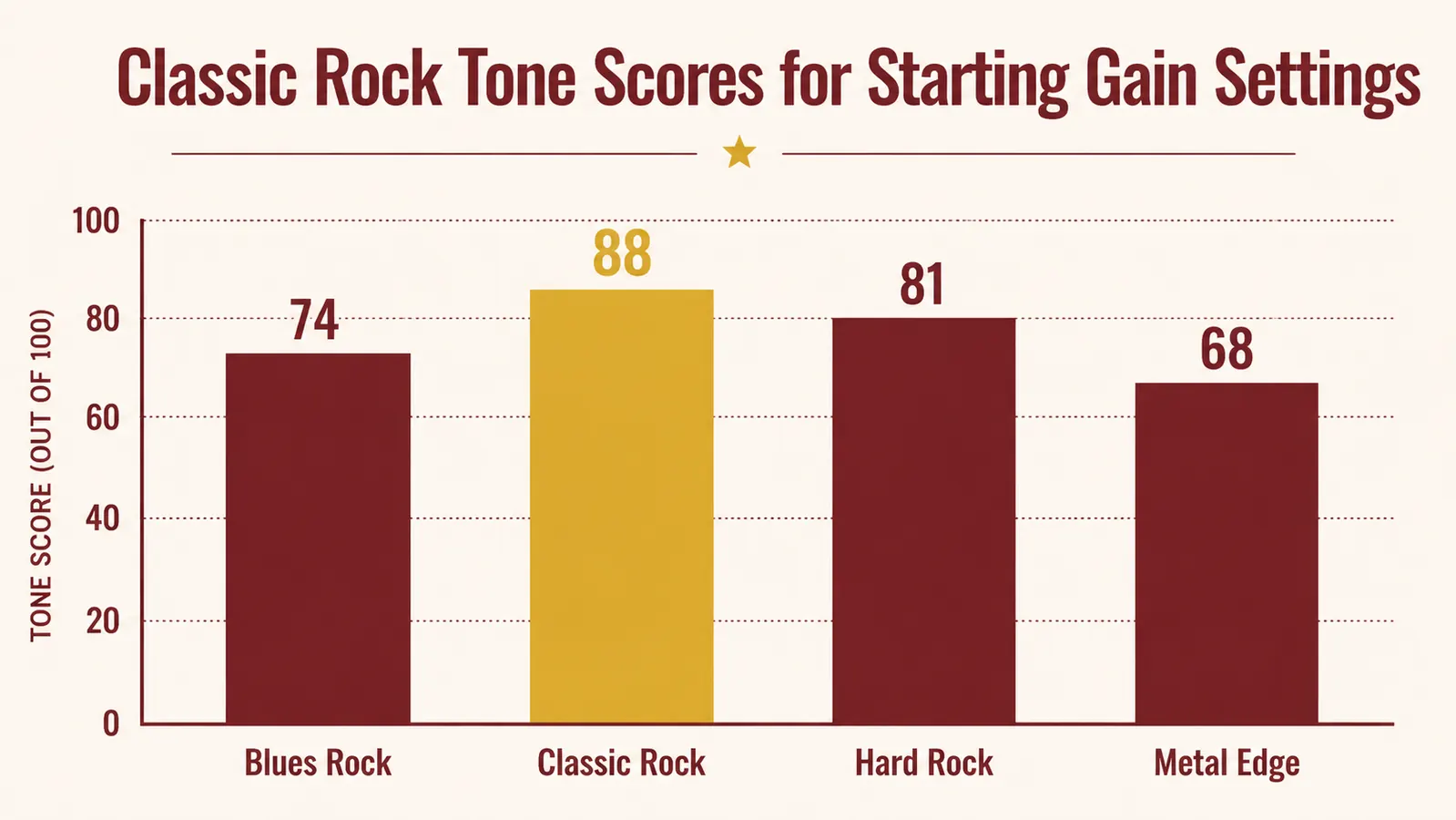
Here are the starting positions I have landed on after three decades of gigs, recording sessions, and way too many hours in music shops comparing patches. These work with a Les Paul or a Strat, on a tube amp or a good solid-state. Start here, then adjust by ear.
Dist: 9 to 10 o'clock. Yes, that low. Maybe 11 o'clock if you want to push toward early Van Halen. Any higher and you start losing note separation on chord work. The DS-1's circuit is designed with a wide gain range because they expected people to use it for metal too. Classic rock lives in the left third of that knob.
Level: 3 o'clock. You want the pedal to drive the amp slightly harder than your bypassed clean signal. If the overall volume drops when you click the pedal on, the Level is too low. If the amp speaker starts compressing and the clean sound disappears, it is too high. 3 o'clock is almost always right for a clean amp platform.
Step 3: Set the Tone Knob to 11 O'Clock, Not Noon
This single adjustment is responsible for more DS-1 conversions than any other change I can think of. The Tone knob on the DS-1 is a high-frequency shelf. At noon it starts to sound harsh on most guitar-and-amp combinations. At 1 o'clock and beyond it sounds genuinely bad, thin and cutting, like a broken transistor radio.
Set it at 11 o'clock. That is one hour counterclockwise from straight up. On a physical DS-1, you are pointing the knob indicator at roughly the 10-on-a-clock-face position. This keeps the top end present enough to cut through a mix, but it rolls off the worst of the fizz that makes this pedal sound cheap in inexperienced hands. Combined with the low-to-medium Dist setting, the result is a warm, harmonically rich crunch that holds together on open power chords the way a pushed Marshall does.
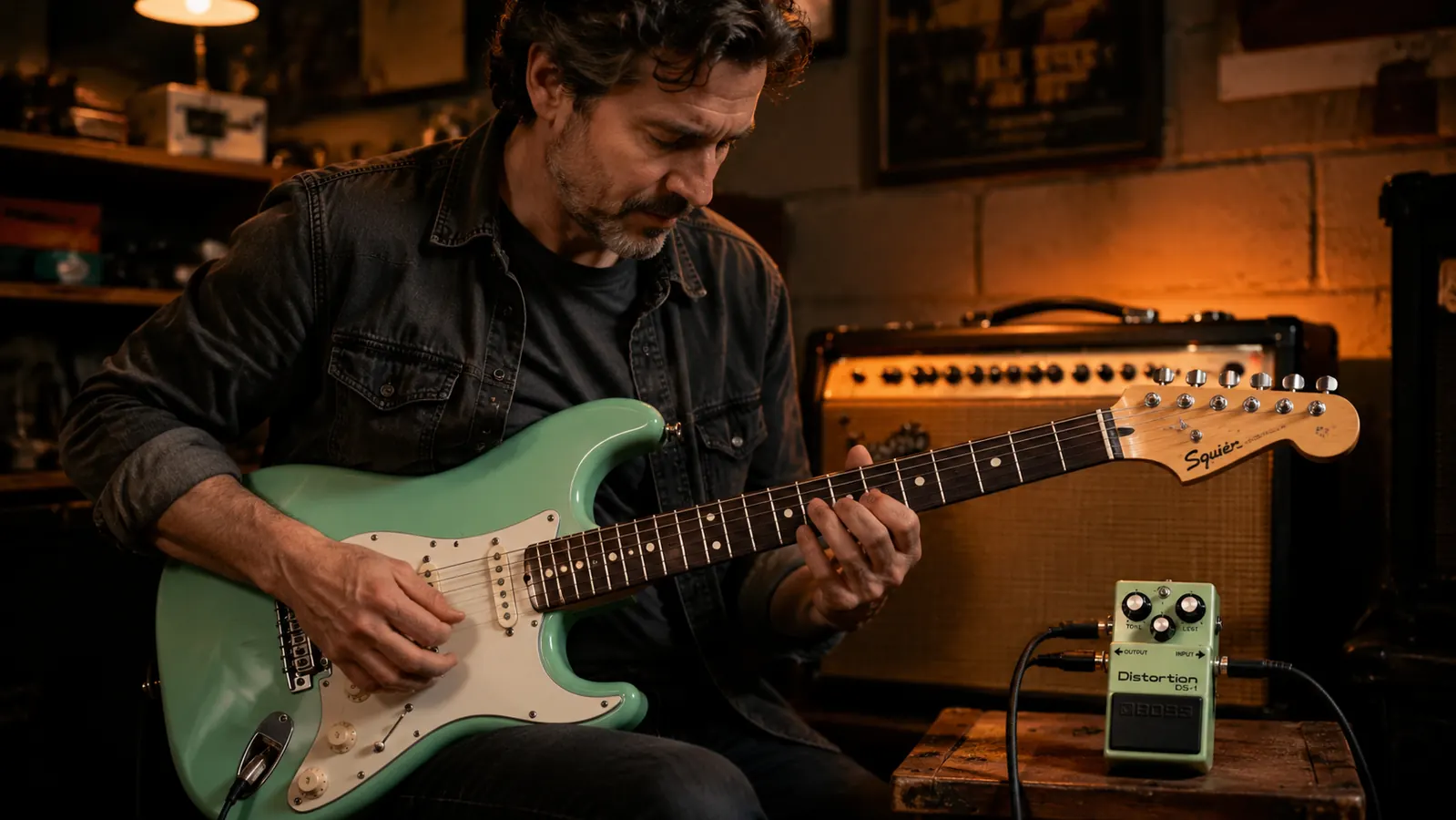
If you are playing a Stratocaster with single-coil pickups, you might nudge the Tone to 11:30 or just barely past 11. Single coils are inherently brighter, so they can handle a touch more Tone knob before the harshness kicks in. If you are on humbuckers, stay at 11 or even back it to 10:30. Trust the setting. It feels weird to have a tone knob below noon, but play through it for five minutes and you will not go back.
Step 4: Stack a Clean Boost in Front of the DS-1
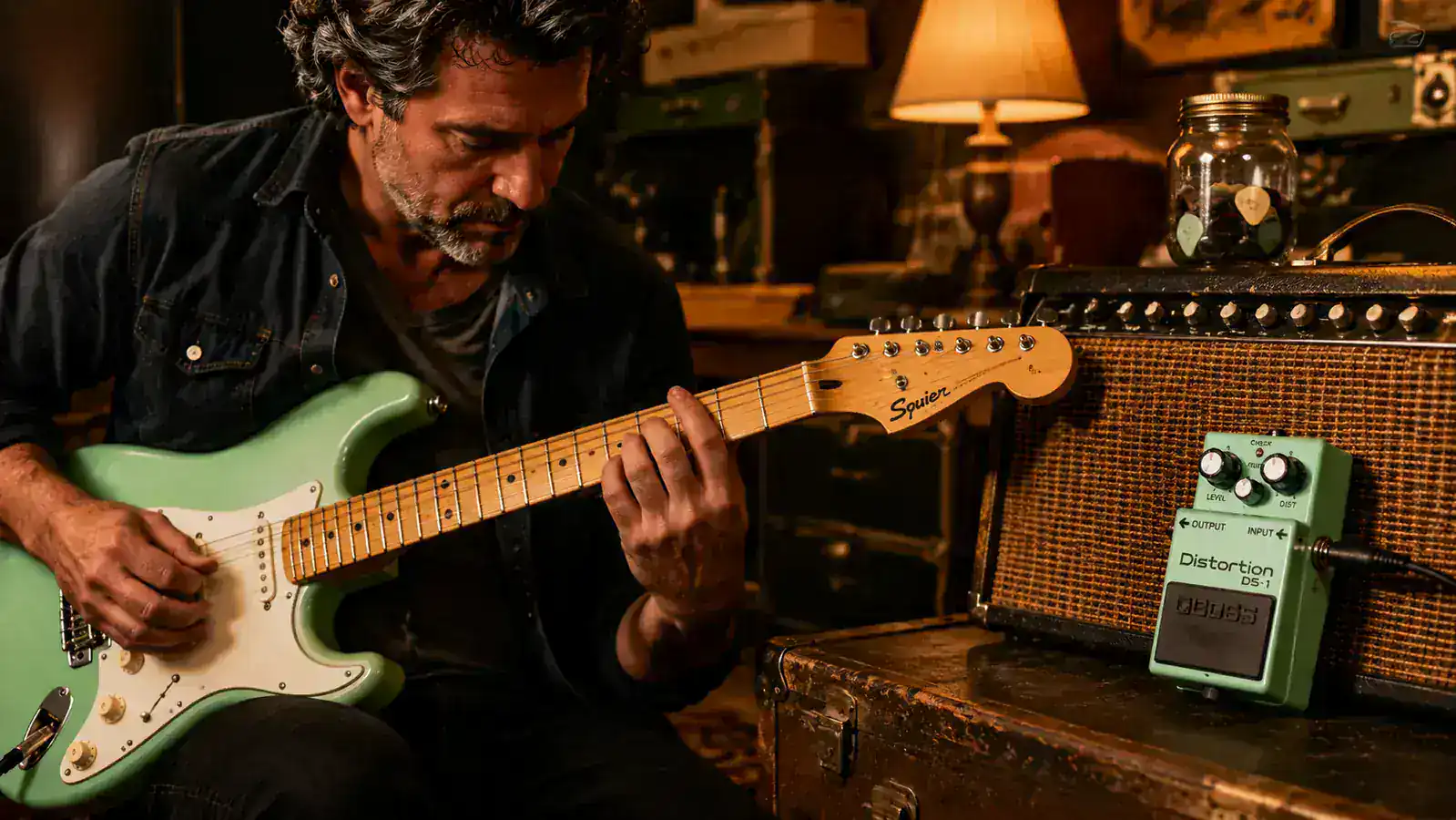
If you want to understand why the DS-1 sounds bigger in some rigs than others, this is the answer. A clean boost pedal placed before the DS-1 in the signal chain increases the input signal hitting the DS-1's clipping stage. That changes the character of the distortion, thickening the low-mids and adding sustain without adding more gain. It is the same reason a buffer or a low-output overdrive in front of a dirt pedal changes the sound so dramatically.
You do not need an expensive clean boost. The TC Electronic Spark Boost, the MXR Micro Amp, the Electro-Harmonix LPB-1, all of these work well. Set the boost level so it adds maybe 3 to 5 dB of signal before the DS-1. Then back the DS-1's Dist knob down just a hair from where you had it. What you get is a fuller, more compressed, more touch-responsive version of the same crunch. This combination is what gets you closest to the way Angus Young's Gibson SG sounded hitting a Marshall's input stage.
A clean boost in front changes the character of the distortion, thickening the low-mids and adding sustain without adding more gain. That is the missing piece most DS-1 guides never mention.
One caution: if you are using a Katana or any amp with its own input gain control, make sure the clean boost is not pushing the amp's preamp into its own clipping stage. Check by bypassing the DS-1 with only the clean boost active. The amp should stay clean. If it starts to overdrive on its own, back the boost level down.
Step 5: Match Your Pickup to the Tone You Are Chasing
Pickup choice matters more than most DS-1 guides admit. The pedal responds very differently depending on what is feeding it.
For AC/DC and early Sabbath tones, a humbucker is the right starting point. Gibson-style humbuckers, PAF-wound around 7.5 to 8.5k output, feed the DS-1's input in a way that produces tight, punchy crunch with good low-mid body. A high-output humbucker above 14k will give you too much gain too fast and muddy up the low strings. If that is what you have, back the Dist knob even further, to 8 or 9 o'clock.
For Rolling Stones and early Faces tones, a Strat in the bridge or middle position works surprisingly well. The thinner single-coil signal gives the DS-1 a brighter, spankier character that is closer to what Keith Richards was doing with his open-tuned Telecasters. Bump your amp's bass knob up a little if the bottom end feels thin.
For Zeppelin tones, Page used Les Pauls and a bow at various points, but the practical answer is: a humbucker into the DS-1 with Dist around 10 o'clock, Tone at 11, and the neck pickup selected for rhythm parts. The neck humbucker's warmer output produces the thick, woolly quality that defined 'Whole Lotta Love' and 'Communication Breakdown.' For lead lines, switch to the bridge pickup and pick harder rather than raising the gain.
Step 6: Let Your Picking Technique Do the Work
At low-to-medium gain settings, the DS-1 is highly responsive to picking dynamics. This is a feature, not a bug. Dig in hard and the pedal compresses and saturates. Pick lightly and it cleans up and blooms. That dynamic range is exactly what you want for classic rock playing, where the difference between a chugging rhythm chunk and a ringing open chord is supposed to be expressive.
The mistake players make at this gain level is trying to play like they are at a higher gain setting. They mute too much, pick too gently, stay too precise. Classic rock rhythm guitar is physical. Angus Young is swinging hard into those chords. Richards is pushing into the strings. Page digs in with authority. Your picking hand should be doing meaningful work, not tiptoeing.
Try this exercise: set everything as described in Steps 1 through 5, then play an E5 power chord with the minimum force needed to sound the notes. Then play it at 80 percent of your maximum picking intensity. Notice how the sustain tail changes, how the upper harmonics bloom, how the chord takes on a three-dimensional quality. That second version is where classic rock crunch lives. Train yourself to play there.
What Else Helps
A few additional variables that affect the result but get left out of most settings guides.
Cables and buffers: Long cable runs absorb high-frequency content before the signal even reaches the DS-1. A good buffer or a tuner pedal with a buffered bypass at the front of your chain solves this. If your tone sounds dull and lacks presence even with these settings, check whether you are running twenty feet of cable with no buffer. You probably are.
Guitar volume knob: The DS-1 cleans up beautifully when you roll your guitar's volume back to 7 or 8. At 10, you get full crunch. At 7, you get a cleaner rhythm tone from the same pedal setting. This is an old trick that players overlook because they are used to leaving the guitar volume wide open. Used properly, it means you can go from clean-ish rhythm to full crunch and back without touching the pedalboard.
Fresh strings: A DS-1 at low gain is quite revealing about string quality. Dead strings lose high-frequency information and the Tone knob has nothing to work with. Fresh strings, even inexpensive ones, make a real difference in how alive the crunch feels. If you are fighting for presence and clarity and everything else is dialed in, check when you last changed strings.
For more on pairing the DS-1 with the right amplifier, the long-term review covers every amp I have run it through over twenty years. And if you are using a modeling amp, the companion guide on classic rock tones for modeling amps covers the platform settings in more detail than I can fit here.
The DS-1 is the most-owned dirt pedal in rock history for a reason. These settings are why.
At around $70, the Boss DS-1 is still the clearest path to classic rock crunch without overthinking your rig. Check today's price and grab one if you do not already have it.
Amazon Check Today's Price on Amazon →