
If you have been standing in a guitar shop or scrolling pedal forums for more than ten minutes trying to decide between the Boss DS-1 and the MXR Distortion+ M104, I understand completely. These two pedals have been confusing players for decades, and for good reason: both are legitimate classics, both cost around the same amount, and both have appeared on records you have loved your whole life. Kurt Cobain ran a DS-1. Randy Rhoads ran a Distortion+. So did Slash, at least early on. The legacy argument is a dead heat.
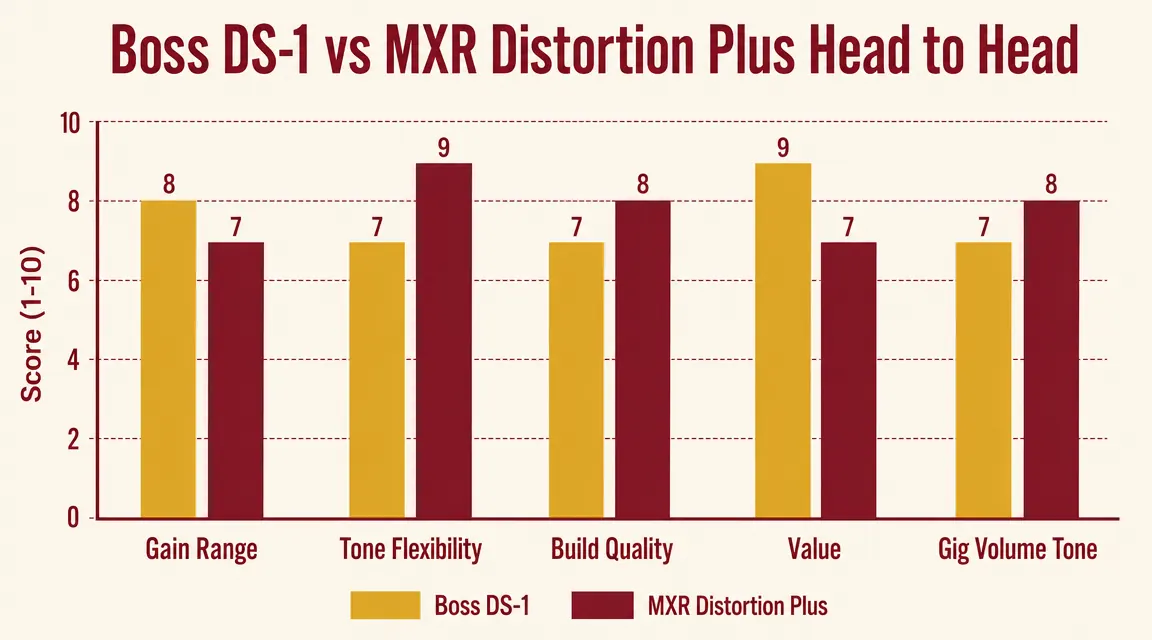
But here is the thing: for the player who needs a single dirt pedal to cover the most ground, the Boss DS-1 wins clearly. It is not even close on versatility. The Distortion+ does one specific thing brilliantly, and if that thing is exactly what you need, it is the right call. But if you are buying your first real distortion pedal and want something that can go from light crunch to full hard rock, the DS-1 is the answer. I have owned both multiple times over 30 years of gigging and I have a pretty clear opinion at this point.
| Category | Boss DS-1 | MXR Distortion+ M104 |
|---|---|---|
| Street Price | ~$70 | ~$80 |
| Controls | Dist, Tone, Level (3 knobs) | Output, Distortion (2 knobs) |
| Gain Range | Light crunch to full hard rock | Warm breakup to moderate drive |
| EQ Shaping | Dedicated Tone knob | Fixed voicing, no tone control |
| Best For | Versatile rock, punk, grunge, metal lite | Classic rock, Randy Rhoads, Slash-style tone |
| Noise Floor | Quiet with good buffering | Very quiet, minimal coloring |
| Power | 9V battery or PSA adapter | 9V battery or adapter |
| Build | Plastic housing, Boss footswitch | Metal housing, standard DPDT switch |
| True Bypass | No (buffered bypass) | No (hardwire bypass) |
| Weight | Lightweight, 0.5 lb | Heavier, all-metal, 0.7 lb |
Where the Boss DS-1 Wins
The Distortion knob on the DS-1 actually does something useful across its entire range. At seven o'clock, barely open, you get a slightly pushed clean with some edge on pick attack. At noon you have a solid classic rock crunch. Crank it past three o'clock and you are in hard rock territory that can push into the front end of a hot amp and get genuinely gnarly. That is a massive working range for $70. I have used it on country gigs where I just needed a little drive on solos, and I have used the same pedal on a punk gig where the whole band was running hot. Different nights, same pedal.
The Tone knob is where the DS-1 really separates itself. The Distortion+ has no tone control at all. Its voice is baked in. The DS-1 lets you roll back the high end if your amp is already bright, or push it forward if you want presence to cut through a live mix. For bedroom players going through a clean-channel modeling amp, that Tone knob can be the difference between a sound that grates and a sound that breathes. It is not the most elegant tone stack in the world, but it works, and the Distortion+ simply does not have it.
Price is another leg up. The DS-1 consistently lands around $70 new, and you can find used units in perfect working condition for $30 to $45 all day long. Boss builds these things to last. I have had DS-1s that spent years in the bottom of a gig bag, survived bar spills and at least one parking lot drop, and still worked fine. The buffered bypass is actually a feature, not a bug, if you run long cable runs between your guitar and amp. Your signal stays strong without a separate buffer. That matters on a real gig.
Ready to stop overthinking it? The DS-1 is on Amazon right now.
The Boss DS-1 is the distortion pedal most players land on for a reason. Versatile gain range, a real tone control, Boss reliability. Check today's price and get it sorted.
Amazon Check Today's Price on Amazon →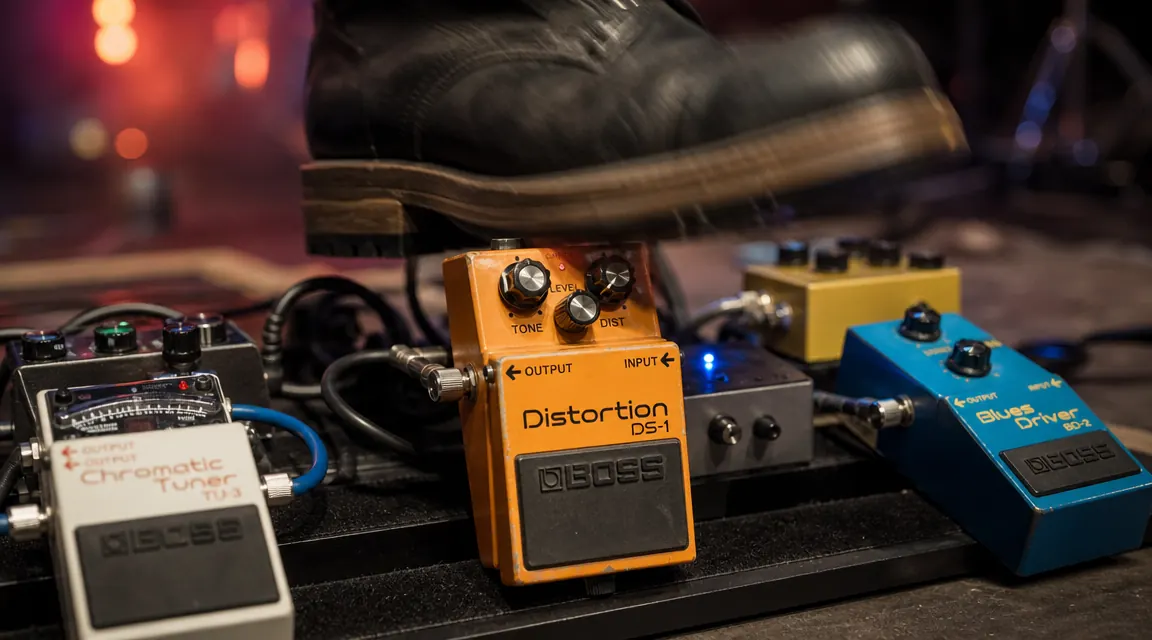
Where the MXR Distortion+ Wins
The Distortion+ has a warmth the DS-1 simply cannot match. It is a germanium-diode clipping circuit, and that means the saturation has a softer, more rounded edge compared to the harder silicon clipping in the DS-1. When Randy Rhoads plugged one into a Marshall JCM800 on the Blizzard of Ozz record, you are hearing exactly that: a warm, thick distortion that still has clarity on chord hits and does not turn into a wall of mud when you dig in. It is a beautiful sound.
For players chasing a very specific late-1970s and early-1980s classic rock tone, the Distortion+ gets you there faster. It stacks beautifully with a cranked amp in a way the DS-1 does not, because the softer clipping character blends into natural amp breakup rather than competing with it. If your signal chain is a Les Paul into a hot-rodded Marshall or a Plexi clone, the Distortion+ will feel more at home. It also tends to be quieter on stage because its signal path is simpler. Two knobs means two things to worry about. Some players love that simplicity.
The Distortion+ does one thing so well that a lot of very serious guitarists never needed anything else. The DS-1 does ten things well enough that most players never run out of room.
Feel and Response: How They Play Under Your Fingers
This is where it gets interesting for players who actually pay attention to dynamics. The Distortion+ is more responsive to picking attack than the DS-1. Roll back the guitar's volume knob and the Distortion+ cleans up noticeably, almost like a light overdrive. That is the germanium circuit behaving the way vintage fuzz pedals behave. You can use your guitar's volume knob to move between dirty and semi-clean, which is a genuinely useful live technique.
The DS-1 is less interactive in that way. It tends to sit at its gain level and stay there regardless of how hard or soft you pick. For some players that is actually a plus, because the sound is consistent whether you are noodling at low volume or digging in hard on a chorus. For players who like to use their picking dynamics as part of their expression, the Distortion+ feels more alive. Neither approach is objectively correct. It comes down to how you play.
The physical footswitch on the Boss is famously solid. The DS-1 uses the same momentary switch and relay-based bypass system as every other Boss compact, and it is virtually indestructible. The MXR's switch is a standard DPDT toggle that works fine but does not have the same bomb-proof feel. After 30 years of stomping on both, I have never had a Boss switch fail on me in a live setting. I cannot say the same for every MXR I have owned.
Tone Voicing: What Each Pedal Sounds Like in the Mix
The DS-1 has a prominent upper-midrange character, especially with the Tone knob past noon. It cuts through a live band mix well because of that presence, but it can also sound harsh through a bright amp or in a dry recording environment. Kurt Cobain's DS-1 tones on In Utero were recorded through a Mesa Boogie amp that was already pretty dark, and that pairing balanced the DS-1's edge. Match it to your amp's voice and the DS-1 sounds great. Ignore the interaction and it can be a bit sharp.
The Distortion+ sits lower in the frequency spectrum. Its mid character is scooped compared to the DS-1, which is why it sounds fat and warm rather than cutting and aggressive. In a full band mix, that lower-mid presence can make it sound a little buried unless your amp has good mid presence already. Alone in a bedroom through a clean amp, it sounds enormous. With a full band at rehearsal volume, you sometimes have to push the Output knob further than expected to stay present. Know that going in.
Who Should Buy Which
Buy the Boss DS-1 if you are buying your first real distortion pedal, if you play more than one style of rock, if you need to cover everything from blues-rock crunch to hard rock drive in a single gig, or if your budget is tight and you want the most reliable pedal in that price range. It is also the right call if you run long cable runs, use a passive guitar, or play through a clean solid-state amp where a buffered bypass helps your signal. The DS-1 forgives more variables and works in more contexts. Most players reading this should buy the DS-1.
Buy the MXR Distortion+ M104 if you have a very specific late-1970s or early-1980s classic rock tone in your head and nothing else will do. If you want Randy Rhoads on Crazy Train, if you play into a cranked Marshall-style amp and want the pedal to blend with that natural breakup rather than stack on top of it, or if you want something that responds to your guitar's volume knob like a vintage instrument responds. The Distortion+ is a more limited tool, but within its range it is exceptional. Do not buy it hoping it will also cover modern hard rock or anything with a tight low end. It will not.
There is also a third scenario: own both. Used DS-1s are $30 to $45. Used Distortion+ units are $50 to $65. For under $100 combined, you have two of the most historically significant dirt pedals ever made, covering genuinely different sonic territory. That is not a bad situation to be in.
A Note on Modifications
Both pedals have thriving mod communities. The DS-1 gets the Keeley Ultra mod, the Analogman mod, and dozens of others that tighten the low end, smooth the tone knob taper, and reduce the harsh top end of the stock circuit. A modded DS-1 sounds noticeably better to most ears. The Distortion+ gets similar treatments, usually focused on swapping the op-amp and diodes to change the clipping character. If you buy the stock pedal and find yourself wanting more, mods are a real and affordable path on both.
That said, plenty of serious players have used the stock DS-1 on major records their whole careers without touching the circuit. Eric Johnson famously ran a stock DS-1 in his chain for years. Steve Vai used one. Before you spend money on a mod, spend time learning to work with the Tone knob and your amp's gain staging. Most players get more improvement from that work than from any circuit modification. I say this as someone who has modded more pedals than I care to count and learned this lesson the expensive way.
The DS-1 is the right call for most players. Here is where to get it.
Over 4,300 Amazon reviews, nearly 50 years of production history, and it still costs $70. The Boss DS-1 earns its reputation. Check today's price and pull the trigger.
Amazon Check Today's Price on Amazon →