
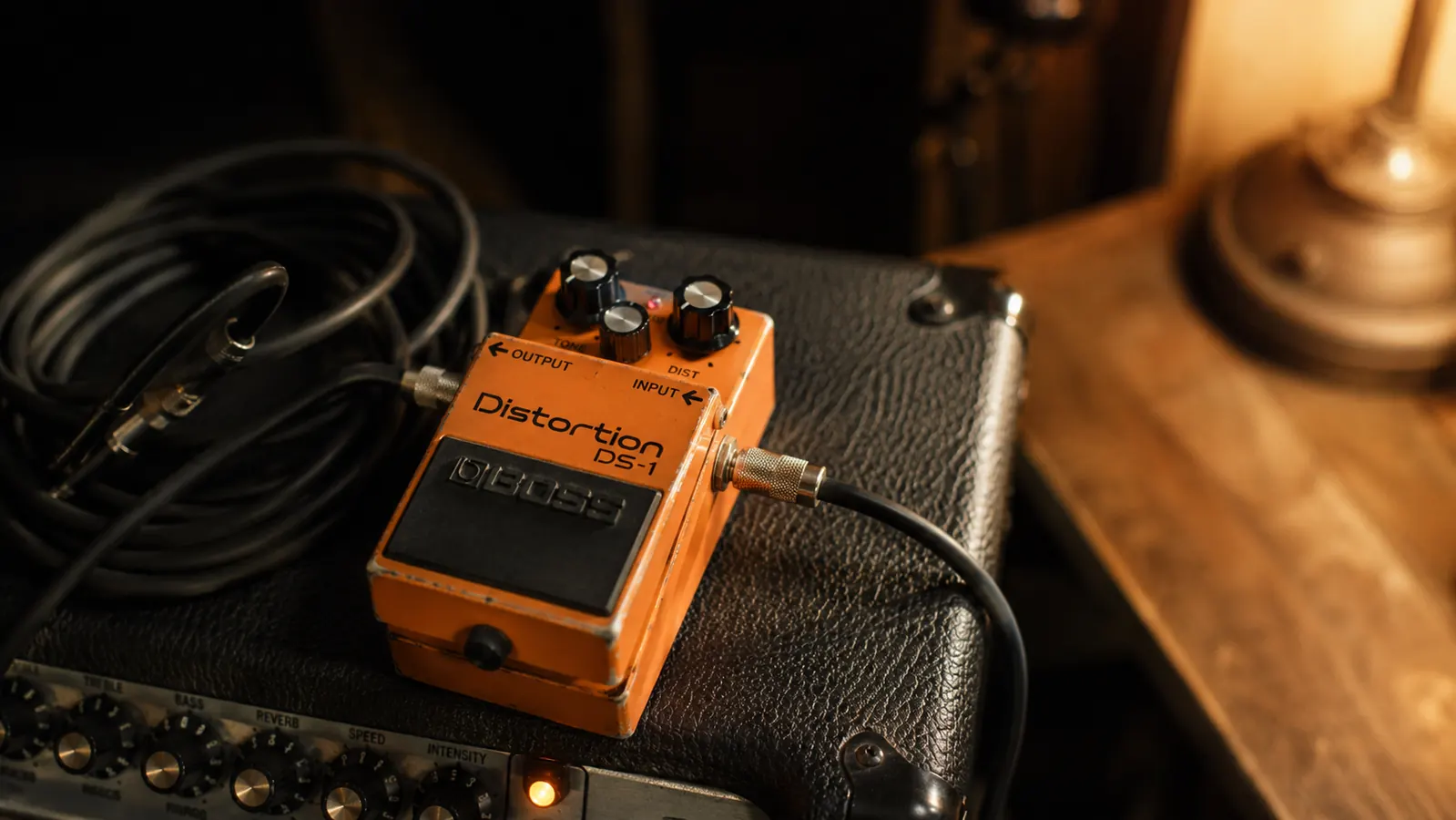
The first DS-1 I ever plugged in was borrowed from a friend's older brother. I was 16, running it into a beat-up Peavey combo in the basement of a house in suburban Ohio. I cranked the Dist knob past noon, hit the open E chord, and something happened in my chest that I still cannot fully explain. That was 1998. I have now owned four Boss DS-1 pedals across 25 years of gigging, recording, teaching, and chasing tones that I will probably never fully nail. The current one has been on my board since 2019. The orange paint on the lower-left corner is flaking off in little crescent chips. The rubber pad on the bottom fell off sometime around 2022, which means it slides a couple of millimeters across the board every time I stomp it hard. I have not replaced the rubber pad. I am not sure I want to. There is something about a pedal that shows its age honestly that I find more trustworthy than one still in its box.
What I am going to give you here is not a spec sheet. Boss's marketing team handles that. What I want to give you is 25 years of using this thing at bar gigs, rehearsals, home recordings, and occasionally too-loud bedroom sessions at midnight. The DS-1 at current pricing sits around $70 on Amazon. I want to tell you honestly whether it deserves a spot on your board, who it is perfect for, and where it will frustrate you.
The Quick Verdict
The most field-tested distortion pedal on the planet for good reason. Workhorse tone at a price that does not hurt, with real flaws you should know about before you buy.
Amazon Check Today's Price →Still searching for your first real dirt pedal? Stop. The DS-1 is $70 and has been the answer to that question since 1978.
Over 4,300 Amazon reviews. Rated 4.6 out of 5. I have owned four of them. You probably only need one.
Amazon Check Today's Price on Amazon →How I Have Used It
I want to be specific here because 'I use it for rock' tells you nothing. My primary board for the last six years runs a Fender Stratocaster into a Boss TU-3 tuner, then the DS-1, then an Ibanez TS9 Tube Screamer, then a Boss DD-8 delay, into a Fender Blues Junior. That chain is not exotic. It is what a lot of people who play classic rock in mid-size rooms end up with after trying a lot of other things.
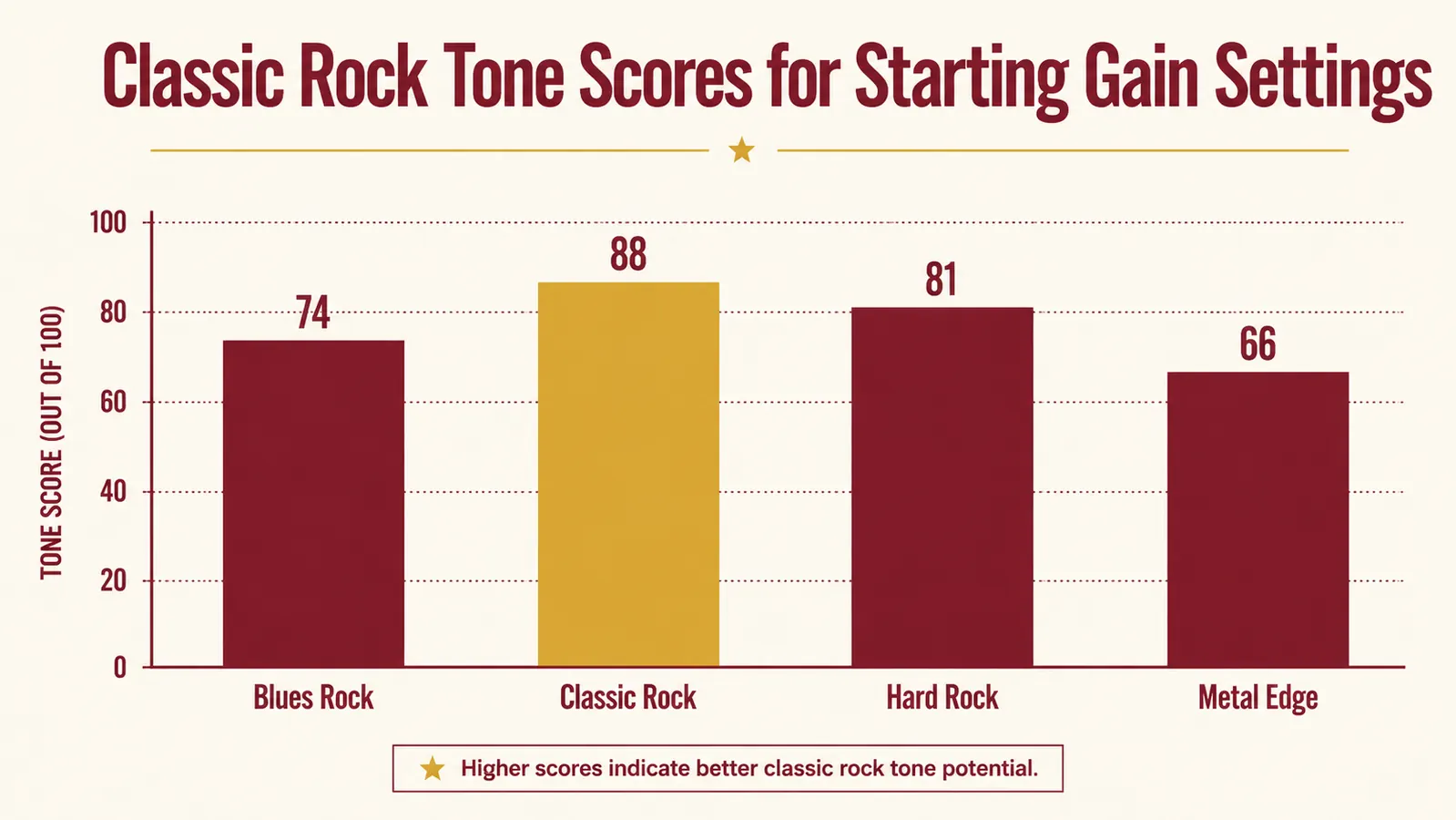
The DS-1 handles three distinct jobs in my playing. First, it is my Kurt Cobain crunch setting. I run the Dist at about 1 o'clock, Tone at 9 o'clock, Level matched to unity. It gets that boxy, slightly scooped grunge sound that works for 'Come as You Are' and 'Lithium' without getting fizzy on palm mutes. Second, it is my AC/DC bridge boost. Malcolm Young's rhythm sound is less about extreme gain than people think. I back the Dist off to 9 o'clock, bump the Level past unity by about 20 percent, and let the Blues Junior do the actual saturation. Third, sometimes I stack it in front of the Tube Screamer for lead tones that need more sustain. DS-1 first in the chain, TS9 second, both on. The result is thicker and more compressed than either pedal alone.
What I have almost never used it for: metal. The DS-1's character is mid-forward and slightly raunchy in a way that works for classic rock and early alternative but does not have the tight low end that metal rhythm tracks need. If you are playing anything tuned below drop D with any regularity, there are better options and I will get to that.
The Tone: What It Actually Sounds Like
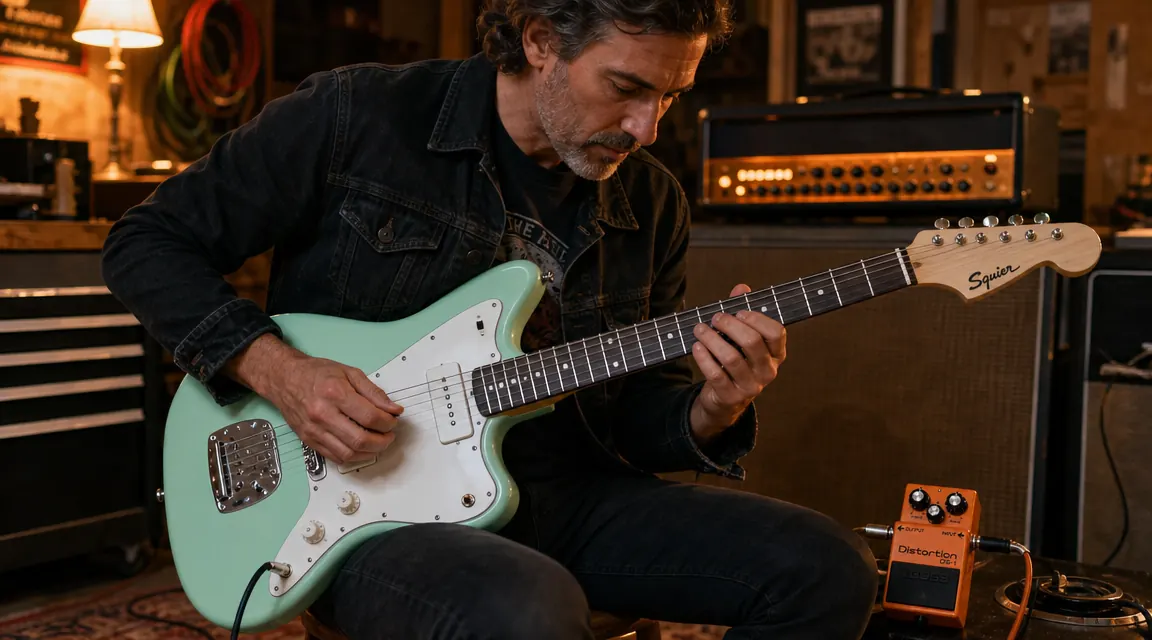
The DS-1 has a specific character that I would describe as 'aggressive but not polished.' There is a roughness to the midrange that some people call 'nasal' and other people call 'present.' It does not sound like a high-end boutique overdrive. It does not sound like a Rat, which is smoother and more compressed. It sounds like a DS-1, and once you have spent a decade hearing one in a live room you recognize it immediately. Kurt Cobain used it. Steve Vai used a modified version. Joe Satriani has talked about it. That tells you it covers a wider ground than its entry-level price suggests.
The Tone knob is the control that takes the most dialing. At higher settings it gets harsh and bright in a way that reads as 'thin' through a cab with scooped mids. At lower settings it rolls off so much top end that the pedal sounds woolly. The sweet spot on most setups I have tried is somewhere between 8 and 11 o'clock, which feels counterintuitive when you first touch it because it looks like you are barely using the treble range. What you are actually doing is fighting the naturally aggressive top end of the distortion circuit so it sits in the mix without cutting through painfully.
The Tone knob feels backward the first three times you use it. Somewhere around the fourth time, something clicks, and you realize it is the most useful control on the pedal.
How It Has Held Up Over the Years
I have had four DS-1 pedals. The first one I lost when a band broke up messily in 2004 and the drummer took it along with my favorite patch cable. The second I lent to a student in 2011 and never saw again. The third I actually wore out: the footswitch started requiring a harder stomp to engage around 2017, and one night at a gig it just stopped switching reliably. Three years of heavy gigging and I would say that is a reasonable lifespan for a stomp switch if you are hitting it hard twice a night four nights a week.
The current one, bought in 2019, is in the condition you would expect. The orange paint has chipped at the lower-left corner where the edge of my pedalboard bag rubs against it. The rubber pad on the bottom detached and disappeared. That last thing is worth noting: the rubber pad on Boss compact pedals is held by nothing except adhesive, and it will eventually let go. If you are buying this to sit on a velcro pedalboard, it does not matter. If you are buying it to use loose on a hardwood stage floor, you will be chasing it slightly every night. A small piece of grip tape on the bottom solves this in about thirty seconds.
The circuit itself has been basically unchanged since the mid-1980s after Boss made a few component swaps in the original run. That is either a mark of confidence or a sign that they stopped caring, depending on how you look at it. My read: the original circuit works, they know it works, and changing it would just upset thirty years of muscle memory for working musicians. Respect.
Stacking With a Tube Screamer
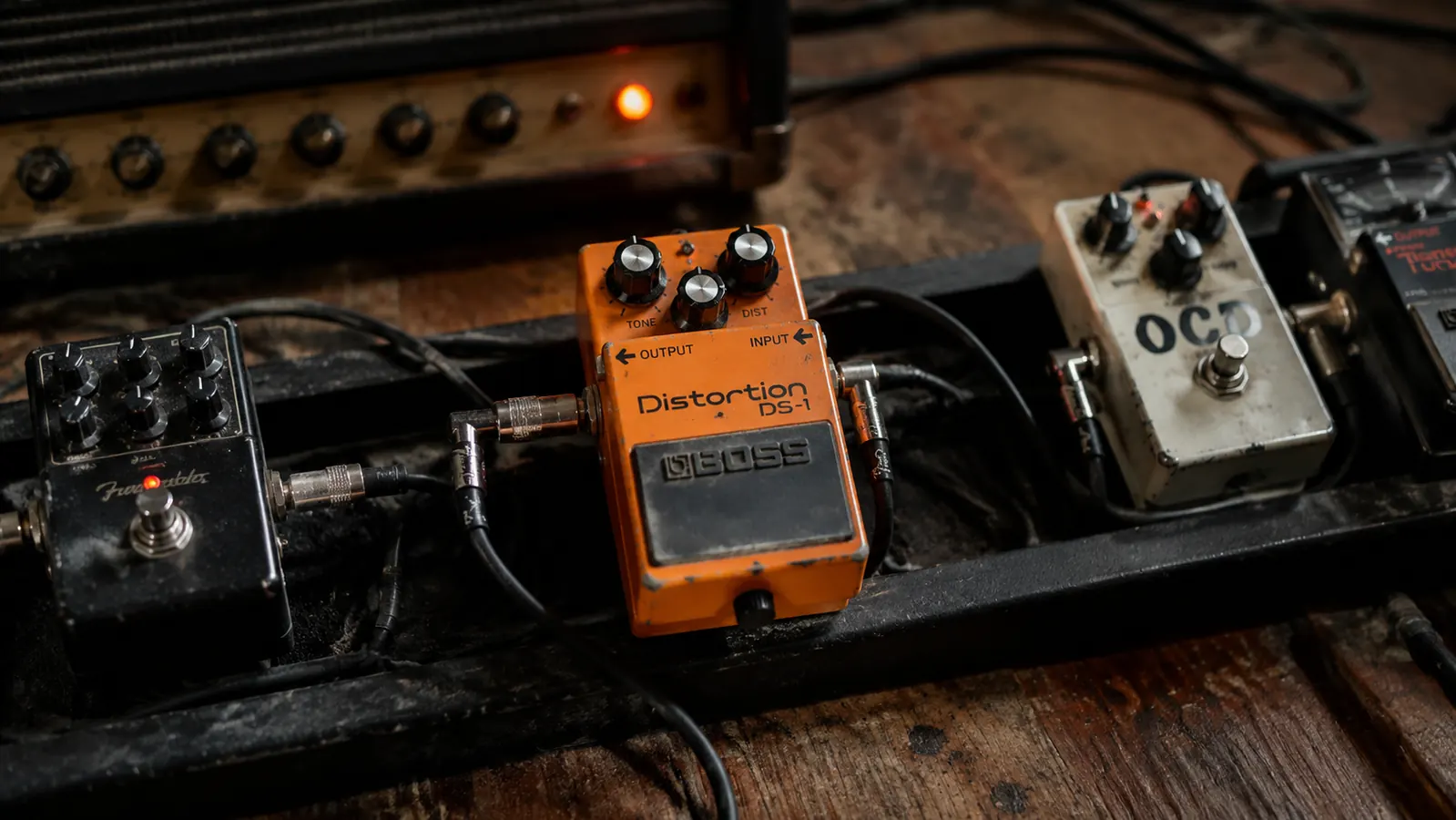
I want to spend a moment here because the DS-1 into Tube Screamer combination is something I stumbled into around 2009 and have not moved away from since. The conventional advice is to run the Tube Screamer before the DS-1, using the TS as a mid-boost going into the distortion. That works. But I prefer it the other way around for a specific reason: running DS-1 first and TS9 second gives you a softer, more compressed distortion than the DS-1 alone. The Tube Screamer's mild compression smooths the attack of the DS-1's circuit so leads sustain longer without getting flabby. If I am playing rhythm I switch the TS off and let the DS-1 run alone. If I am going into a lead I kick both on.
This is not a setup that works on every amp. On clean-headroom amps like a Fender Twin or a Roland Jazz Chorus it sounds huge. On an already-saturated amp channel it can get washy. The key variable is how much headroom your amp has at the volume you are running. More headroom means more room for the stacked pedals to do their thing without turning into mush.
The Modification Question
Every DS-1 article eventually gets to this. There are dozens of DS-1 modification guides online. The most common involve swapping specific op-amp chips and diodes to change the clipping character and soften the Tone knob's aggressive curve. Keeley makes a professionally modded version. Several boutique shops offer their own takes. I have played modded DS-1s and they are genuinely different, more rounded and 'expensive-sounding' in the way boutique overdrives are.
My honest take: the stock DS-1 at $70 does what it does very well. If you spend $150 getting it modded you are now at $220, which is boutique overdrive territory, and you should probably just buy a boutique overdrive instead. The modifications are worth it if you have a stock DS-1 already and are curious, or if you are handy with a soldering iron and want a project. They are not worth it as a buying strategy.
What I Liked
- Proven circuit used by actual touring musicians for 40-plus years
- Extremely rugged housing: the cast zinc body has survived more drops than I can count
- True bypass or buffered bypass depending on the version, both work well in a chain
- Stacks cleanly with Tube Screamer for lead-tone boost
- Nail AC/DC rhythm, Kurt Cobain crunch, and early-alternative edge in one $70 box
- 4,300-plus Amazon reviews averaging 4.6 stars is not manufactured hype
Where It Falls Short
- Tone knob requires careful dialing; easy to land in harsh or woolly territory
- Not ideal for high-gain metal: low end gets loose below drop D
- Rubber bottom pad will detach over time
- Paint chips if you move it in a bag without a protective layer
- Stock DS-1 has a brightness that can be fatiguing in long high-volume sets without careful EQ
Who This Is For
You are the right buyer for a DS-1 if you play anything from classic rock through early alternative and you do not want to spend $150 or more on a boutique drive. You are right for it if you want a pedal that will run off a 9V power supply, fit on any board, and still work reliably after a decade of gigging. You are right for it if you are a beginner who needs a real distortion sound without a real distortion budget. The DS-1 is the kind of pedal that stays on the board of a seasoned player not because they cannot afford something fancier but because they tried fancier things and came back.
It is also a solid choice if you want a single pedal that you can dial back for Angus Young territory, dial up for Cobain territory, and occasionally stack for something that sounds like a moderately unhinged British amp. That is a lot of ground for $70.
Who Should Skip It
If you play metal, especially anything in the modern tight-palm-mute vein, the DS-1 will not satisfy you. The low end is not tight enough and the overall character is too loose and mid-forward for chuggy rhythm playing. Look at the Boss MT-2 Metal Zone, the Electro-Harmonix Metal Muff, or a Boss HM-2 if you are going in that direction. If you want a smoother, creamier overdrive for blues-rock, look at the Tube Screamer or the Boss BD-2 Blues Driver first. The DS-1 has a specific personality and it is not a chameleon. If that personality does not match the music you make, no amount of knob-turning will fix it. I say this as someone who genuinely loves the pedal.
Also skip it if you need pristine bypass switching and have a very elaborate effects loop with high-impedance vintage pickups and tube amps. The buffered bypass on most DS-1 units can color your clean tone slightly. It is not a deal-breaker for most players but it is worth knowing if you are running a complex chain.
If you play classic rock, grunge, or early alternative, there is no better first distortion pedal at this price. The DS-1 has been the answer for 40 years.
Boss DS-1, ASIN B0002KYY14. Rated 4.6/5 from 4,362 reviews. Runs on a standard 9V power supply. Built like a tank, sounds like a working musician's pedal.
Amazon Check Today's Price on Amazon →