
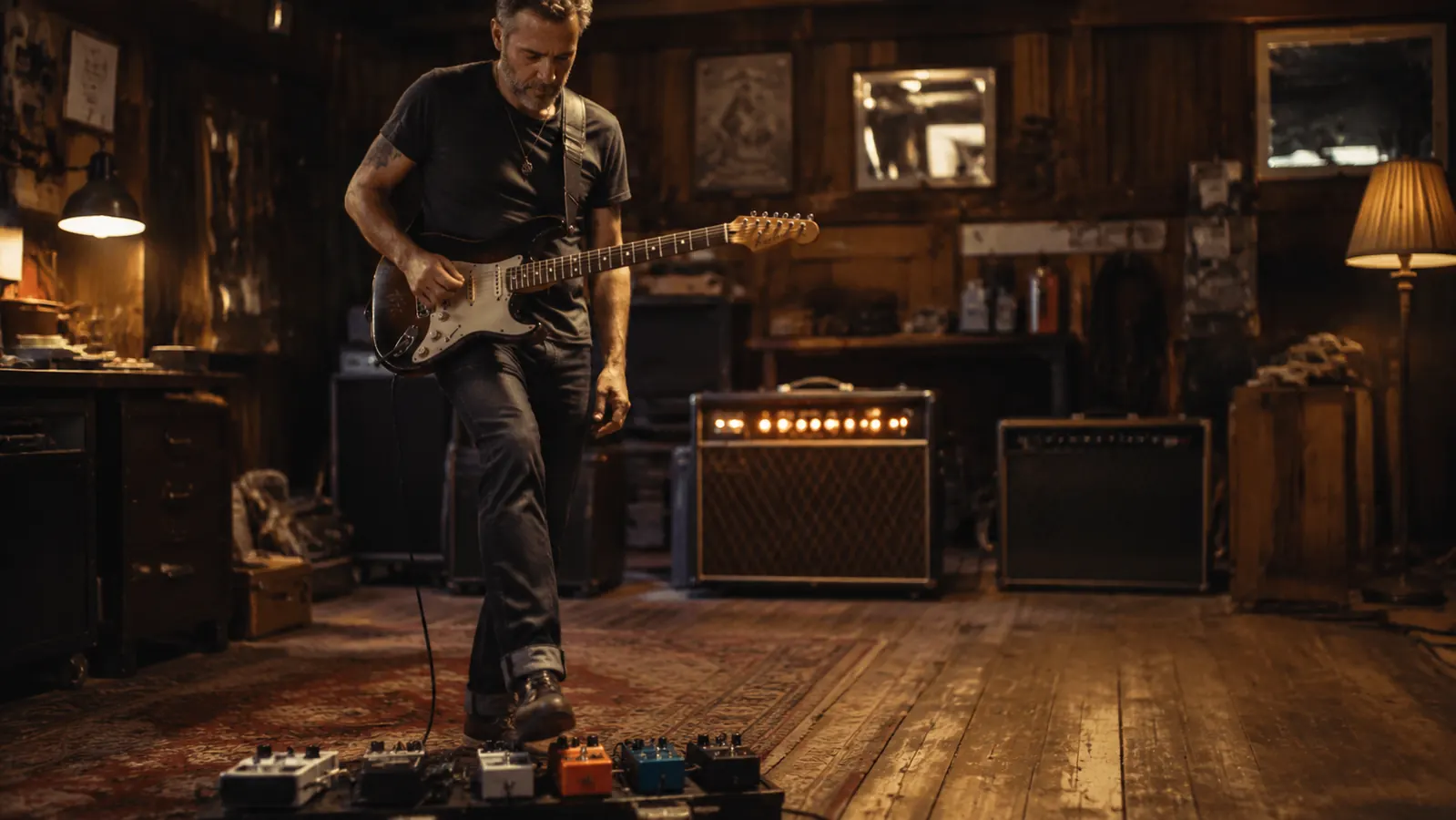
Let me be upfront with you about something: I have a complicated relationship with the Boss DS-1. I bought my first one at 16 from a pawn shop in Tucson for $30. I've owned four of them total over the past 30 years. I've gigged with them, recorded through them, and spent more hours than I care to count tweaking them on practice-room floors. So when someone asks me if the DS-1 is actually good, my honest answer is: it depends on what you mean by good. Because there are two very different conversations about this pedal happening at the same time, and they're both sort of correct.
The first conversation is the nostalgic one. Kurt Cobain used it. Steve Vai used it. It launched in 1978 and it has never left production. Over 4,362 Amazon reviewers have weighed in, and the average rating is 4.6 out of 5. At $69.99, it is the default answer every time a beginner asks what distortion pedal to buy. All of that is real. The second conversation is the one that happens in recording studios and on gear forums, where working players talk about the DS-1's midrange character with something between reverence and frustration. That conversation is also real. I am going to walk you through both.
The Quick Verdict
An iconic, nearly indestructible dirt box that sounds great through the right amp at the right volume, but has a honky midrange character that becomes a liability in the studio and at low bedroom levels. The mods exist for a reason.
Amazon Check Today's Price →Still the best $70 you can spend on your first dirt pedal
Four decades of production, used by everyone from Cobain to Vai, and built to survive a world tour. Before you spend four times more on boutique distortion, see what the stock DS-1 actually sounds like first.
Amazon Check Today's Price on Amazon →What Nobody Talks About: That Midrange
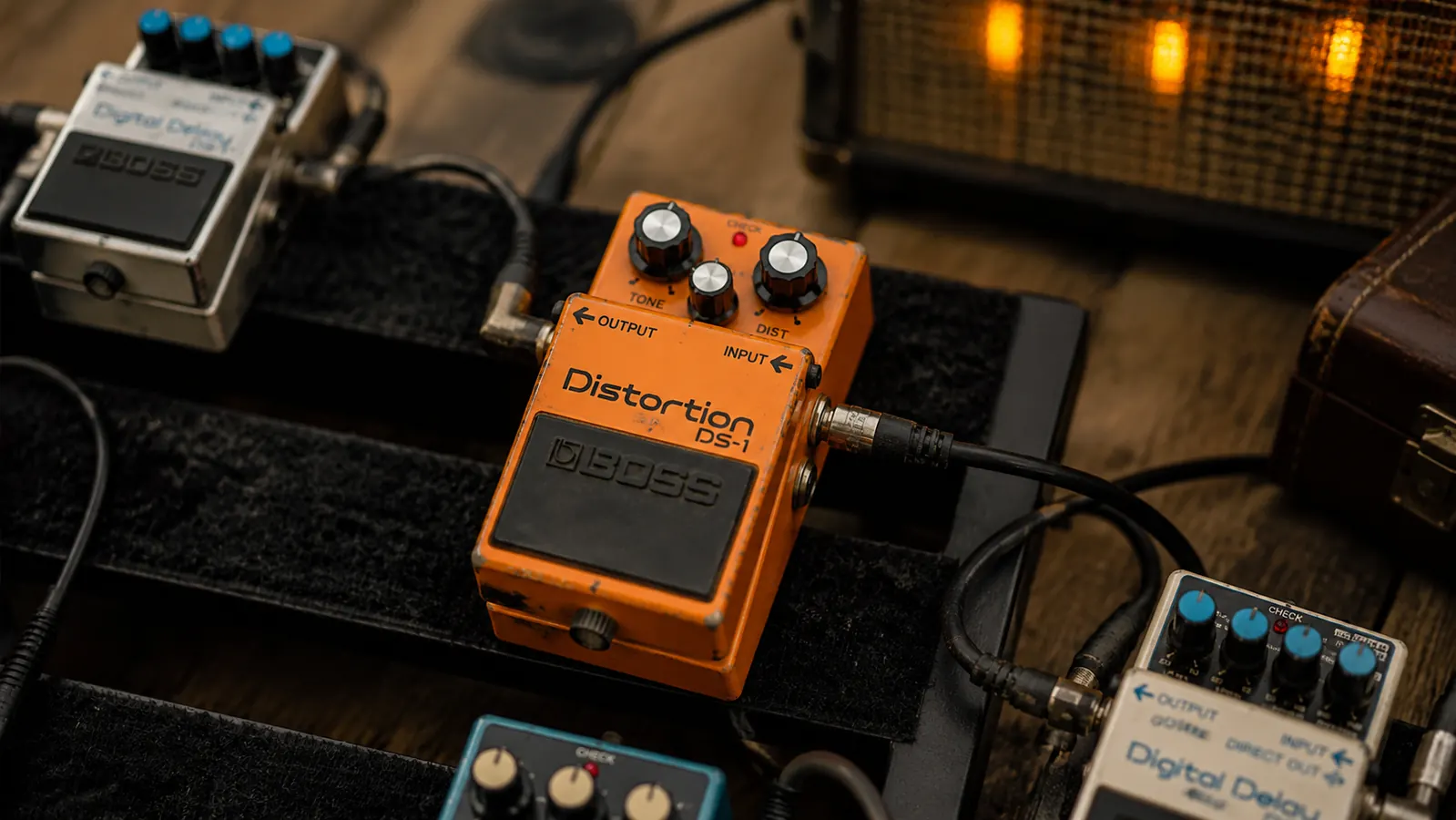
The Boss DS-1's defining sonic characteristic is a peak in the upper midrange, somewhere around 1 to 2 kHz, that engineers call honky. It is the same frequency range where a telephone filters out, where nasally voices live. In a mix, at stage volume, running through a bright amp, it can cut right through the band. Playing live in a loud rock context with a Marshall or a Fender at reasonable volume, this is an asset. The pedal is voiced to sit on top of a band, not underneath it.
The problem shows up in two specific contexts: recording and bedroom playing. When you mike up an amp and run that signal through a console or an interface, the DS-1's midrange gets even more pronounced. What sounds like a thick, cutting distortion in the room starts to sound thin and nasal in the mix. Engineers compensate with heavy EQ cuts around 1.5 kHz and a low-mid boost to add body. If you're spending session time fixing the pedal's EQ character, you're paying for the fix on top of the $70 pedal price.
The bedroom problem is slightly different. At low volumes, the way our ears perceive bass and treble shifts, and the DS-1's built-in midrange emphasis becomes even more obvious because you lose the low end that would otherwise balance it. The pedal genuinely sounds better at pub volume than at practice volume. That's not a flaw in isolation, since lots of gear is amp-volume dependent, but it means beginners who buy it for bedroom use are often disappointed.
The Tone Knob Problem (and Why It's Actually Useful Once You Understand It)
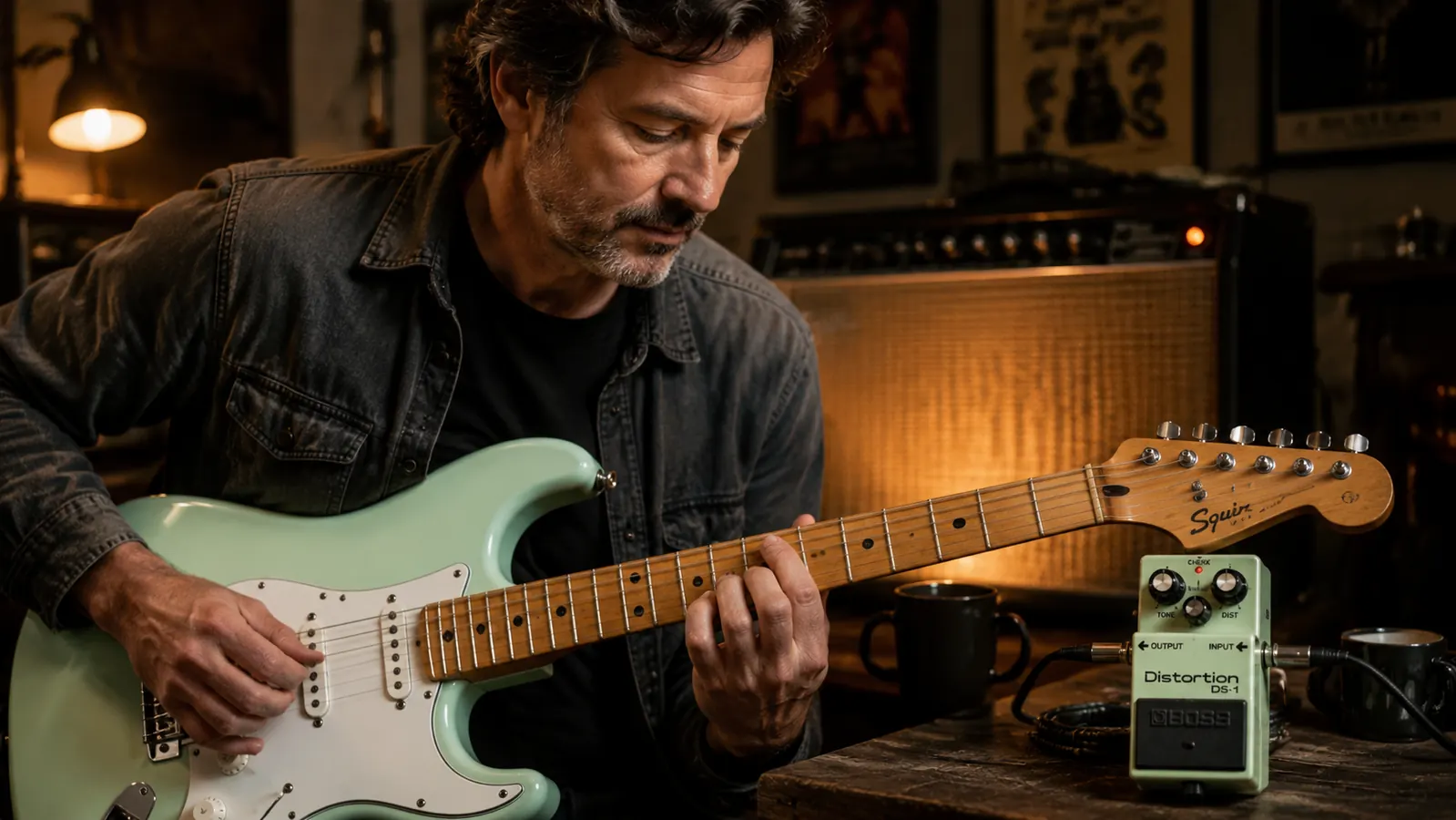
The DS-1's tone knob is a passive high-pass filter, and it is notoriously touchy. The full sweep from 7 o'clock to 5 o'clock does almost nothing useful in about 80 percent of its range. The sweet spot is genuinely narrow, somewhere between 9 and 11 o'clock for most amps. Below that, the pedal sounds woolly and thick in a way that kills note definition. Above it, you're back in telephone territory. Most DS-1 owners either don't know this or they spend months dialing in the wrong range before they accidentally find the sweet spot.
Here's what I do: I set the tone around 9:30 on a brighter amp like a Fender or a Vox, and around 10:30 on a warmer amp like a Marshall or a Soldano. Then I leave it alone. The mistake is treating it like an active EQ with a useful linear response across its whole range. It isn't. Once you stop fighting it and just accept where the good sounds live, the pedal becomes much more usable.
The DS-1 doesn't fail you. You fail the DS-1 by not understanding what it actually is: a midrange-forward slab of distortion that was designed to cut through a loud band, not to sit politely in a bedroom mix.
Why Pros Mod It: Keeley, JHS, and What They're Actually Fixing
The modding ecosystem around the DS-1 is enormous, and it tells you something important about what players think of the stock pedal. Robert Keeley built a reputation on his Ultra mod, which is still one of the most popular DS-1 modifications in the world. JHS has its own variant. YouTube has entire channels dedicated to DS-1 mods. The fact that so many experienced players spend money to modify a $70 pedal instead of just buying a different pedal is revealing.
What the Keeley Ultra mod does: it replaces several of the clipping diodes, adjusts the gain staging to clean up some of the harsh intermodular distortion, and adds a low-frequency shelf to give the pedal more body. The result is a smoother, more amp-like distortion that still has the DS-1's punch and cutting character but without the harsh upper-mid spike. Players who've heard both back to back often describe the Keeley version as what the stock pedal should have been from the factory.
The JHS mod goes a different direction, adding a clean blend and a voicing switch that essentially lets you use the pedal as a slightly different animal entirely. Both mods cost $50 to $80 when done by a shop, which means you're now into a $120 to $150 pedal. At that price point, you're competing with boutique options. That math matters.
Stock DS-1 Through a Real Amp vs Through a Recording Interface
I have run the Boss DS-1 through a lot of different signal chains over 30 years. Through a loud tube amp with some natural breakup already happening, the DS-1 sounds genuinely great. It's not subtle, and it's not trying to be. You get a thick, loud, somewhat aggressive wall of distortion that sits right in the middle of the band's sound and dares the bass player to compete. Early Nirvana sounds. Young early-90s alt-rock sounds. That's the DS-1 in its natural habitat.
Run the same pedal directly into an interface through an amp sim, and it's a noticeably different experience. The amp sim adds its own coloring, and the DS-1's midrange spike interacts badly with bright-voiced sims like many of the Marshall-based models in popular software. You end up fighting with EQ on both the sim and potentially in your DAW to get something that doesn't sound like it came out of a transistor radio. The pedal was designed in an era when everyone ran into real amps. It shows.
One practical workaround: if you're recording with a DS-1 into a sim, use a warm, darker-voiced amp model (something Vox or Plexi-based at low gain) and let the pedal do the heavy lifting on distortion. This pulls back on the brightness interaction and gives you more control over the final EQ character in your DAW. It works better than it sounds like it should.
How It Actually Compares to a Fulltone OCD and a Tube Screamer
Let's address the comparison that comes up in every gear forum eventually. The Fulltone OCD runs around $130. The Ibanez Tube Screamer (TS9) runs around $100. Both cost significantly more than the DS-1's $69.99. Are they worth the difference? My answer: it completely depends on what you're doing.
The Tube Screamer is a fundamentally different-sounding pedal. It has a pronounced low-mid warmth and a compression quality that makes chords sound thick and single-note lines sound smooth. It is not a high-gain pedal. Running a TS9 at full gain still sounds relatively polite compared to a DS-1 at 9 o'clock. If you want searing distortion, the TS isn't built for it. It's built to push an already-breaking-up tube amp over the edge. Used that way, it's extraordinary. Used as a standalone distortion unit into a clean amp, it sounds thin and compressed. So calling it a replacement for the DS-1 is a category error.
The Fulltone OCD is a more direct comparison. It's a higher-gain overdrive that can get into genuine distortion territory, and its EQ character is significantly more balanced than the DS-1. It doesn't have that upper-mid spike. It sounds more natural and amp-like. It also cleans up beautifully when you roll back your guitar's volume knob, something the DS-1 does only passably. In a recording context, the OCD is meaningfully easier to work with. At gig volume through a loud amp, the gap narrows. The DS-1 has an aggressive forward quality that can actually work in its favor on a loud stage, where subtlety is not the priority.
What the DS-1 does that neither of the others can: it costs $70, it's available in every music store on Earth, and it'll survive being run over by a guitar tech's equipment case. If it breaks, you buy another one. That indestructibility and accessibility matters more than boutique players typically acknowledge.
What I Liked
- Virtually indestructible build, proven over 40+ years of production
- Cuts through a loud band mix like almost nothing else at this price
- Tone knob has a genuine sweet spot that rewards patience
- Takes mods exceptionally well if you want to invest in one later
- Standard Boss power supply compatibility, no battery guessing games
- Kurt Cobain, Steve Vai, and John Frusciante can't all be wrong
Where It Falls Short
- Honky upper-midrange character is a real liability in studio recording
- Sounds noticeably worse at low bedroom volumes than at stage volume
- Tone knob's usable range is narrow and counterintuitive to dial in
- Interacts poorly with bright amp simulators in a DAW context
- Stock version doesn't clean up gracefully when you roll back guitar volume
- Modding it to fix the midrange issues costs more than the pedal itself
Who This Is For
The DS-1 is the right pedal if you play live in loud rock or punk contexts, run through a real amp, and want a pedal that won't fail on stage. It's right for players who are just getting started and need to understand what a dirt pedal actually does before spending more money. It's right for the gigging band member who might drop it, spill beer on it, or leave it in a van in January. It's right for players who are specifically chasing the Cobain or early Frusciante sounds, because that voicing is genuinely part of what made those recordings sound the way they do.
Who Should Skip It
The DS-1 is the wrong pedal if you record primarily into a DAW through an audio interface and struggle with harsh tones. It's wrong if you practice mostly at bedroom volumes and keep wondering why your distortion sounds thin and fizzy. It's wrong if you're chasing smooth, vocal lead tones, because that's not its voice. And it's wrong if you want something that cleans up beautifully from guitar volume roll-offs, because the OCD or a quality overdrive will serve you much better there. None of this makes the DS-1 a bad pedal. It makes it a specific pedal, and knowing which category you're in matters before you spend even $70.
Before you spend $130 on boutique distortion, try the one that started it all
The DS-1 has outlasted most of the boutique competition that tried to replace it. If you're playing loud, live rock through a real amp, there's still nothing smarter at this price. Check what it's going for today before you commit to anything else.
Amazon Check Today's Price on Amazon →