

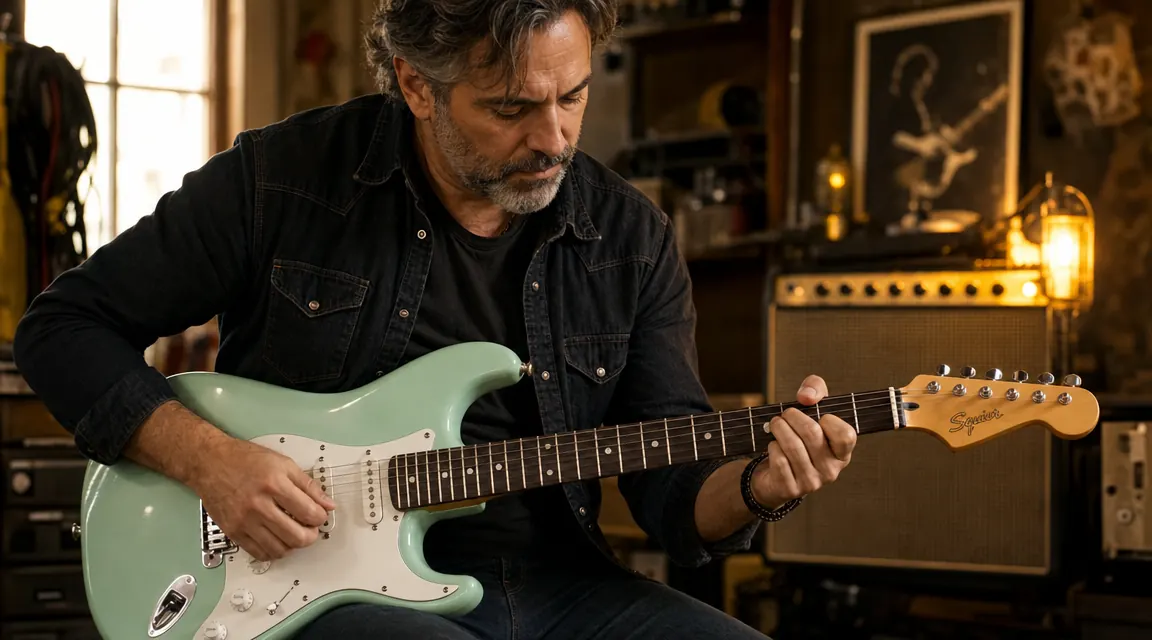
Let me tell you what happens when you walk into a music shop with $400 in your pocket and ask about Stratocasters. The guy behind the counter hands you a Fender Player and watches your face fall at the price tag. Then he says, "But have you tried the Squier Classic Vibe?" And that guitar, that Squier Classic Vibe '50s Stratocaster, feels so good in your hands that you almost feel guilty it isn't the Fender. Almost. I have been playing guitars for over 30 years. I own 11 of them. I have gigged with $3,000 American Standards and $150 pawn-shop beaters. When the Classic Vibe first hit my hands, I had one specific question: what did they cut to get here at this price? Because something always gets cut.
This is not the glowing unboxing review. This is the review where I tell you about the pickup hum at gig volume, what the fret ends feel like after the finish dries out, the tremolo block situation that every budget guitar has and nobody films, and the honest answer to whether the Fender Player is worth paying double. If you want the six-months-of-gigging long-form picture, we have that too over at the long-term review. But right now, let's get into what the promo content didn't show you.
The Quick Verdict
A genuinely impressive guitar at this price, with real-world limitations the YouTube crowd isn't telling you about. Worth buying. Not perfect out of the box.
Amazon Check Today's Price →If you're already sold, check the current price before it moves.
The Classic Vibe '50s Strat sits around $400 but fluctuates. Amazon updates the price regularly and it sometimes dips. Worth checking now before you read 2,400 words and find it sold out.
Amazon Check Today's Price on Amazon →How I Actually Tested This Guitar
I did not just noodle through it in the living room and call it a review. I ran this guitar through a Princeton Reverb reissue at bedroom volume, through a Marshall DSL40CR at rehearsal volume, and through a clean Fender Twin at small-venue volume where the room starts to breathe and you can actually hear the instrument instead of just the amp. I also ran it into a UAD Apollo with a Neve preamp so I could hear the pickups dry. That last test is where the gaps show up.
I compared it directly to a Fender Player Stratocaster I borrowed from a friend who plays in a local cover band, both through the same amp, same cable, same settings. I weighed both guitars. I measured neck profiles at the first fret and the twelfth. I checked fret ends before and after playing for two hours. I am not a lab. But I have spent 30 years developing opinions about why some guitars feel like tools and others feel like instruments, and this guitar sits right at the line between the two.
The Pickup Hum Nobody Warns You About
Single-coil pickups hum. That is physics, not a flaw in this guitar specifically. Every Strat you have ever loved, from a '62 original to a late-80s American Standard, hums when you roll up the gain and stop touching the strings. The Classic Vibe's Alnico III single-coils are vintage-voiced and genuinely pleasant at low to medium volume. At bedroom volume through a clean amp, they are the whole reason this guitar sounds as good as it does.
Here is what changes at gig volume. When you are standing three feet from your amp at rehearsal levels, the pickup hum becomes an active presence in the room. It is not disqualifying. Hendrix had it. SRV had it. But it is louder than you expect if you have been testing the guitar through headphones or at low volume. If you are playing rock with any kind of gain stage, a TS9 in front, or the crunch channel on your amp, that hum sits right behind your notes in a way that makes some players reach for the volume knob. Fender handles this in the Player series with a noiseless pickup option. The Classic Vibe does not offer that at this price point. You will either learn to manage it with your picking hand or you will want to swap the middle pickup for a reverse-wound version eventually. That is a $60 fix, not a $400 return.
The position-2 and position-4 quack tones, the in-between settings, are hum-canceling because of the way the pickups interact. Most of your rhythm playing will live in position-2 anyway. But worth knowing before your first gig.
The Fret-End Situation
Out of the box, the fret ends on my review unit were acceptably smooth. Not American Custom Shop smooth, but acceptable. The C-shaped maple neck feels good when you unwrap it and the lacquer finish has that glossy vintage look that photographs beautifully for every YouTube thumbnail. Here is the part that does not get covered in unboxing videos: what happens after six to eight weeks of playing.
Maple necks sealed with a gloss poly finish expand and contract with humidity changes. As the wood moves slightly over the first couple of months, fret ends that felt fine on day one can start to feel like small spurs on the side of the neck. This is not unique to Squier. It happens on Player series Fenders too. But on a guitar at this price point, the fret leveling and crowning from the factory is less precise than what you get at higher price points, which means those spurs can develop faster or more noticeably. A quick fret-end filing with a fret-end file from any hardware or lutherie supply takes maybe 20 minutes and costs nothing if you own the tool. But if you do not own the tool and do not know how to do it, a setup from your local tech runs $40 to $60 and is worth doing in the first month.
At bedroom volume, those Alnico III pickups sound like the reason people still love Strats after 70 years. At gig volume, you find out what a guitar actually is.

The Tremolo Block: What They Cut and Why It Matters
The tremolo system on the Classic Vibe '50s is a six-screw vintage-style unit with a cast zinc block. The block is the metal mass that the springs attach to and the strings pass through. On a real '50s-era Fender or a higher-end modern reproduction, that block is cast steel or, in the best cases, a machined brass unit. Steel sustains longer. Brass sustains even longer and warms the tone slightly. Zinc sustains less, transfers less resonance to the body, and sounds somewhat thinner on the dry recorded signal.
At gig volume through a well-driven amp, you will not hear the difference. Seriously. The room acoustics, your amp, and your playing dominate everything. Where you hear the block difference is in two places: on a clean amp with single-note lead lines where sustain on the high strings matters, and in a direct recording situation with minimal processing. The Classic Vibe's zinc block compresses the sustain on high-E lead lines noticeably compared to a steel-block trem. If you ever sit in recording sessions, this is worth knowing. If you play bar gigs and rehearsals, it is basically irrelevant.
The good news: aftermarket steel trem blocks for the Classic Vibe's six-screw pattern run $25 to $50 on Amazon. Drop-in install, maybe 45 minutes. That is the first upgrade I would make if recording was a regular part of my use case.
Neck Profile vs the Fender Player: What the Specs Don't Tell You
The Classic Vibe '50s has a "soft V" neck profile. Not a hard V like a 1957 original, but a subtle ridge along the back of the neck that you feel under your thumb when you play. Some players love this. It keeps the thumb anchored and makes chord grips feel solid. Players who come from a Gibson background, where the neck is thicker and rounder, often prefer it to the flat modern-C profile. Players who are used to playing shred guitars or a thin modern profile sometimes hate it.
The Fender Player Stratocaster uses a modern-C neck that is considerably flatter front-to-back. The difference at the first fret is noticeable if you switch guitars mid-rehearsal. The nut width is the same on both, 1.650 inches, so string spacing feels identical. But the back-of-neck shape is genuinely different and nobody who is comparing these two guitars online goes into enough detail about it. If you have ever played a late-90s American Standard and liked the neck, the Player feels more familiar. If you have ever played a vintage or vintage-reissue guitar and liked that chunkier feel, the Classic Vibe's soft V is the better fit.
I prefer the soft V for rhythm playing and chord work. For lead lines above the twelfth fret, I slightly prefer the Player's flatter profile. Neither is objectively right. But if you can get to a music store and pick up both before buying, spend 10 minutes on the C versus the soft V before you decide.
Classic Vibe vs Fender Player: The Real Comparison
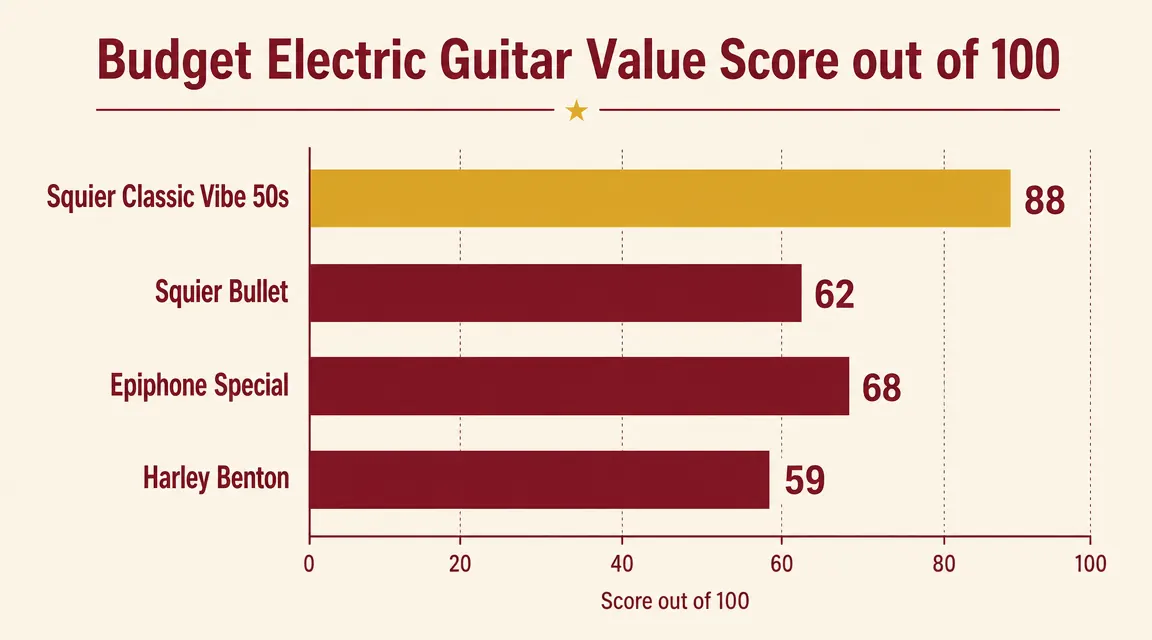
Here is the side-by-side at a glance. The Classic Vibe '50s Strat lands around $400 with a poplar body, a soft-V neck profile, Alnico III single-coil pickups voiced for a vintage tone, vintage-style non-locking tuners, a cast-zinc tremolo block, a synthetic bone nut, a 9.5-inch fretboard radius, and a slightly thicker vintage street feel. It is built in China. The Fender Player Stratocaster lands at roughly $799 with an alder body, a modern C neck profile, Alnico V single-coil pickups voiced brighter and louder, the same vintage-style non-locking tuners, the same cast-zinc block, the same synthetic bone nut, the same 9.5-inch radius, and a slicker modern feel. It is built in Mexico. Two of those nine specs are meaningfully different and the rest are essentially identical.
Here is the uncomfortable truth about the comparison above. The Fender Player and the Squier Classic Vibe share the same tremolo block material. They share the same basic tuner style. They share the same nut material. The Player uses alder for the body, which resonates slightly differently than poplar, but neither sounds dramatically different through an amp in a band context. The Player's Alnico V pickups are a bit brighter and louder, which some players interpret as better. Others prefer the warmer, lower-output vintage character of the Alnico IIIs in the Classic Vibe. The Player costs double.
What you are paying the extra $400 for with the Player is country of origin, quality control consistency, and the Fender headstock decal. The MIM (Made in Mexico) Fenders have better factory setup consistency in my experience. Not dramatically better, but noticeably better. If you get a well-set-up Classic Vibe, or you are willing to have it set up by a tech, the gap between these two guitars on a stage narrows to nearly nothing.
What I Liked
- Alnico III pickups have genuine vintage warmth that most budget guitars can't match
- Soft V neck profile is comfortable for extended chord-based playing
- Tremolo is stable enough for gigging if properly set up
- Body resonance and acoustic volume are surprisingly good for a guitar at this price
- Surf Green, Olympic White, and Sunburst colorways all look authentically vintage
- At the current street price, the value-to-quality ratio beats anything else in the $300-$500 bracket
Where It Falls Short
- Zinc tremolo block limits sustain on recorded lead lines compared to a steel-block upgrade
- Pickup hum at gig volume is real and noticeable for players coming from humbuckers
- Fret-end finish dries out within the first two months and often needs a quick dressing
- Factory setup is hit-or-miss; a $50 professional setup is worth doing before you judge it
- Soft V neck divides players; if you prefer a modern-C you will want to feel this before buying
- Tuners are not locking; if you use the tremolo hard you will be re-tuning between songs
What to Upgrade First (and What to Leave Alone)
If you buy this guitar, here is the upgrade order I would follow. First, get a professional setup. Truss rod, action, intonation, nut slot depth. This alone transforms the guitar and costs $40 to $60. Second, if you record at all, swap the tremolo block for a $35 steel aftermarket unit. Third, if the hum bothers you on stage, replace the middle pickup with a reverse-wound version (around $25 to $60 depending on brand). That is it. Beyond those three things, you are chasing tone by spending money when you should be spending money on amp time.
What to leave alone: the neck. The maple-board soft-V neck is the best part of this guitar. Do not swap it. Also leave the tuners alone unless you are doing aggressive vibrato playing. The vintage-style tuners hold tune fine for normal use. Players who are doing Hendrix-style heavy bar work will want to look at locking tuners, but that is a $40 to $60 swap and not urgent.

Who This Is For
The Classic Vibe '50s Strat is the right guitar if you want a vintage-voiced Stratocaster, you are not recording in a studio situation where the zinc block matters, and you either know how to do a basic setup or you are willing to pay for one. It is also right if you want the aesthetic of a '50s Strat at a fraction of what a Vintage Modified or American Original costs. Players in cover bands doing classic rock, blues, and anything in the Hendrix-to-SRV range will find this guitar completely gig-worthy with a proper setup.
Who Should Skip It
If you need a noise-free stage guitar, look at HSS configurations or active pickup guitars. If you hate vintage-C and soft-V neck profiles, the Player series or an Ibanez RG might suit you better. If you are primarily a studio player where every dry note matters, spend the extra and get a guitar with a steel tremolo block from the factory. And if you hate doing setups or paying for them, any guitar under $600 is going to frustrate you in some way.
If you want to dig into the string upgrade that pairs well with this guitar, check out the D'Addario EXL110 review. The 10-46 set pairs with the Classic Vibe's factory nut slots without needing a re-cut, and the slightly brighter character of the nickel-wound strings balances the Alnico III warmth nicely.
Still the best Stratocaster under $500 if you know what you're getting into.
Almost 1,000 Amazon reviews at 4.5 stars. Most of the negative ones are from people who didn't get a setup done. Handle that first and this guitar will surprise you every time you pick it up.
Amazon Check Today's Price on Amazon →