

Let me ask you something. When was the last time you actually stopped and questioned why you buy D'Addario EXL110s? Not 'they sound good' or 'they feel fine.' Why these strings, specifically, every single time? Because I have been buying them since 1994 and for most of that time I could not have given you a better answer than 'that's just what I get.' The EXL110 is the guitar string equivalent of the middle lane on the motorway. Safe, predictable, and full of people who forgot to think about what they were doing.
That is not entirely fair. The D'Addario EXL110-3D is a legitimately good string. It has 4.8 stars on Amazon with over 20,000 reviews, and that number is not built on autopilot purchases alone. But I want to dig into the actual question: is it the best 10-46 nickel-wound string you can buy right now, or is it just the string everyone lands on because it is everywhere, it is consistent, and nobody ever got fired for ordering D'Addario? The answer is more complicated than the forums want you to believe.
The Quick Verdict
The EXL110 earns its popularity through dead-reliable consistency, but players who care deeply about feel or longevity have real reasons to look elsewhere.
Amazon Check Today's Price →Want the string that never surprises you? That is not an insult.
The D'Addario EXL110-3D comes in a three-pack, which is the correct way to buy guitar strings if you change them more than twice a year. Check today's price on Amazon before you buy them at the music shop for twice as much.
Amazon Check Today's Price on Amazon →How I've Used These Strings
I have run EXL110s on at least half my guitars for three decades. They went on my first decent Strat back when I was playing covers in bars for gas money. They have been on my Les Paul Studio, my Telecaster, a PRS SE that I regret selling, and my current main guitar, a 2009 Gibson SG Standard I call 'the Persuader.' I have bought them individually, in three-packs, and once in a bulk ten-set order when I was doing a lot of recording and changing strings before every session.
I have also deliberately taken breaks from them over the years to force myself to compare. I spent six months exclusively on Ernie Ball Regular Slinkys. I ran Elixir Nanowebs for nearly a year. I tried a box of Ernie Ball Cobalt strings after a friend in a touring band would not stop talking about them. Each time I had a clear reason to come back, or a clear reason to stick with what I found. That context matters for everything I am about to tell you.

The 'Boring' Reputation Is Real. Here Is Why It Exists.
When guitarists call EXL110s boring, they are not wrong. They are just describing the wrong thing. The EXL110 does not have a character the way a coated string does, or an emphasized top-end brightness the way a fresh set of Ernie Ball Cobalts does. It has a sound that sits exactly in the middle of what nickel-wound strings are supposed to do. There is no personality quirk. It does not ring like a piano or growl like a wound string from a smaller manufacturer. It just sounds like an electric guitar.
That neutrality is actually a feature for a huge percentage of players. If you are running the string into a vintage-voiced amp or a pedal with a strong character of its own, you probably do not want the string to have opinions. The EXL110 stays out of the way. Producers who track guitars in real studios will tell you that boring strings that hold tune are worth far more than exciting strings that go sharp under your index finger by the third take.
The boring reputation also comes from the fact that every guitar teacher, every music shop assistant, and every online forum starter-pack recommendation has pointed beginners toward EXL110s for forty years. So the string gets associated with 'what you buy before you know better,' even though a lot of pros never leave them.
Why Professionals Default to Them Anyway
I have been in three different cover bands, played roughly 400 gigs over the years, and spent a lot of time around touring and semi-pro players. The string conversation comes up constantly in green rooms and rehearsal spaces. And what you find, once you get past the gear-acquisition posturing, is that a surprisingly large percentage of experienced players are quietly using EXL110s because they simply have no reason to change.
The consistency argument is not trivial. I can buy a set of EXL110s in an airport music shop in Toronto and get the exact same feel as the set I bought at my local shop two years ago. The tolerances on D'Addario's manufacturing are extremely tight. Every plain G string is the same plain G string. Every wound A string is wound the same way. When you are playing a show and your high-E snaps between songs and you reach into your bag for the spare you keep there, you need to know that the replacement string is going to behave exactly like the one it replaced. That matters more than whether the string has an exciting tonal character.
The EXL110 does not have a character, and for most players in most situations, that is exactly correct. The string should stay out of the way of the music.
Tuning stability is genuinely excellent on these strings once they are stretched in. They do not fight you. They do not creep sharp or go flat oddly. On a properly set-up guitar, a fresh set of EXL110s that have been stretch-broken for twenty minutes will stay in tune through a two-hour rehearsal without complaint. That is not universal across the string market. Some budget strings and even some well-regarded alternatives have more tuning drift under real playing conditions.
Where Elixir Nanowebs and Ernie Ball Cobalts Actually Beat Them
Here is where I will lose some of the EXL110 faithful. There are two specific situations where the EXL110 is not the right answer, and pretending otherwise is the kind of comfortable lie that gear forums tell themselves.
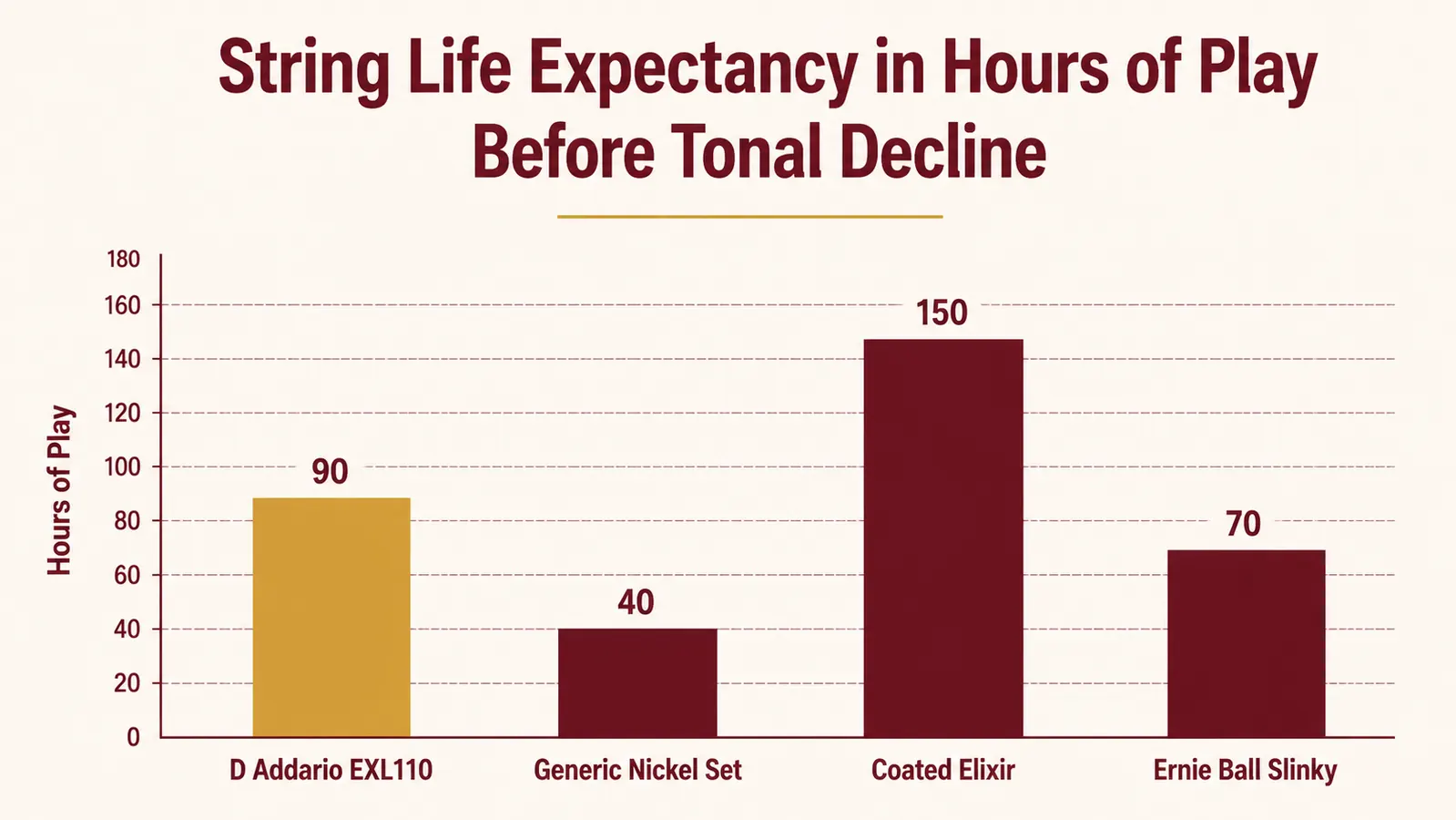
The first situation is longevity. If you are someone who only changes strings every two or three months because life gets in the way, the Elixir Nanoweb is a genuinely better buy even at the higher price. The PTFE coating on Elixir strings keeps sweat and skin oils from killing the tone in week two. On uncoated strings like the EXL110, the wound strings start to sound noticeably dull around the three to four week mark if you play regularly. The Nanoweb will still sound like a live string at eight or ten weeks. The math works out in Elixir's favor for low-frequency changers, and there is no point pretending otherwise.
The second situation is output and bite. Ernie Ball Cobalt strings have a noticeably higher magnetic interaction with your pickups because cobalt is more magnetically responsive than standard nickel alloy. If you play a humbucker-equipped guitar through a relatively clean amp and you feel like you are fighting for presence, Cobalts will give you a noticeably fatter, more defined signal without touching your tone controls. I played them for about four months on the Persuader running into a Fender Blues Junior and the difference was real. The EXL110 sounded polite in comparison. If you are chasing output and attack without buying a new pickup, Cobalts are worth a try. They are not for everyone, but for a specific type of player with a specific rig, they solve a real problem that the EXL110 does not.
Elixir Nanowebs also win on the feel dimension for certain players. The coated surface is slicker. Some players love this for fast lead work because the string releases under the fingertip more easily. Others hate it because they want the slightly tacky, grippy feel of an uncoated string for bending and vibrato control. If you are in the first camp, Elixirs feel objectively different from EXL110s and many players find them easier to play quickly.
The Slick-Feel vs Grippy-Feel Debate Nobody Wins
This is a real divide among players and it is deeply personal. The EXL110 has a slightly textured, grippy surface right out of the pack. After a few hours of playing it gets a little smoother as the string breaks in. Some players find this ideal for expressive playing, bending, vibrato, anything where you want to feel like the string is pushing back against your fingertip. It gives you feedback. Blues players and classic rock players who bend constantly tend to gravitate toward this quality.
Players who come from a classical or fingerstyle background, or who do a lot of economy picking and string-skipping lead work, often prefer the smoother feel of a coated string. There is less resistance, which means faster movement across strings. Neither preference is wrong. But if you have tried EXL110s and felt that the string was slightly fighting you on fast passages, that is a real thing you are noticing and switching to Elixirs or another coated string might genuinely improve your playing speed. The EXL110 does not apologize for being grippy.
The Single-String Failure Rate: One in Fifty Is Not a Rumor
I want to be upfront about this because I have seen it and it is real. There is a failure mode in EXL110s where a single string in a set, usually the high-E or B, is defective from the pack. Not broken, exactly, but either kinked from being wound wrong on the spool, or with an inconsistency in the winding that causes it to break at a specific point under tension almost immediately after stringing. In my personal experience, across hundreds of sets over three decades, I estimate this has happened maybe five or six times. Roughly one in every fifty sets.
That is a low rate by any manufacturing standard. But it is not zero. And when it happens to you the day before a gig, or mid-session in a recording studio where you just tuned up and dialed in your tone, it is genuinely annoying. D'Addario's quality control is among the best in the string market, which is why the rate is so low. But the 3D three-pack format is partly your insurance policy here. Always have a spare set on hand.
The failure mode is not unique to D'Addario. Every string manufacturer has defective units. But because EXL110s are so widely used, the defect stories circulate more often and can create the impression of a systemic quality problem. It is not. It is the normal attrition rate for any mass-produced precision product.
The Price Creep Problem
I remember when you could buy a single set of EXL110s for around three dollars at a music shop. That world is gone and it is not coming back. The EXL110-3D three-pack currently runs around twenty dollars on Amazon, which works out to roughly seven dollars per set. That is not outrageous for a quality string in 2026, but it is meaningfully higher than it was five years ago and the trajectory has been consistently upward.
The price creep matters because one of the traditional arguments for the EXL110 over Elixir was value. Elixirs cost more but last longer. The math used to tilt toward changing EXL110s frequently at a low per-set cost. As the EXL110 price rises, that calculation shifts. If you are getting four weeks out of an EXL110 set and twelve weeks out of an Elixir set, and the Elixir now costs only two and a half times as much per set, the Elixir is either the same cost or better depending on your change frequency. The EXL110's value proposition is narrowing.
Buying the three-pack format is still the right move if you stick with EXL110s. The per-set price in the three-pack is significantly better than buying individual sets, and you will use them. The 3D packaging also has a vapor corrosion inhibitor in each individual string envelope, which does extend shelf life if you keep spare sets in your gig bag for months at a time.
What I Liked
- Remarkable manufacturing consistency across every batch
- Excellent tuning stability once properly stretched in
- Neutral tonal character suits almost any amp or pedal chain
- Three-pack format drops per-set cost significantly
- VCI packaging keeps spare sets fresh in your gig bag
- Widely stocked everywhere, so replacements are easy to source live
Where It Falls Short
- Tone dies noticeably within 3-4 weeks of regular playing
- Slightly grippy feel will frustrate players who prefer coated smoothness
- One in approximately fifty sets has a defective individual string
- Price has risen substantially in recent years, narrowing the value advantage over coated strings
- No magnetic output advantage for players with low-output vintage pickups
- No 'wow' factor on first installation the way fresh Cobalts deliver
Who This Is For
The EXL110 is the right string for anyone who changes strings regularly (every three to six weeks), plays through a higher-gain setup where the string's tonal neutrality works in your favor, and wants absolute confidence that every set they open will behave identically to the last. It is the right choice for gigging players who keep spares in their bag and need consistent behavior under pressure. It is the right choice for recording guitarists who do not want the string adding color to the tracked tone. It is also the right choice if you are just starting out and need something reliable while you figure out your preferences, because the EXL110 will not teach you bad habits or give you misleading information about what your guitar actually sounds like.
If you are already on EXL110s and they are working for you, I would genuinely not tell you to change. The forum crowd that treats string experimentation as a moral imperative has it wrong. There is nothing broken about using the most popular string in the world when that string is actually very good at what it does.
Who Should Skip It
Skip the EXL110 if you only change strings every two months or more. The Elixir Nanoweb will serve you better, and over a year the cost difference is negligible. Skip them if you play a humbucker guitar through a relatively clean amp and feel like you are always fighting for presence and definition. Try Ernie Ball Cobalts for a few sets and see whether the added magnetic output makes a real difference in your setup. Skip them if you genuinely hate the grippy feel of uncoated strings and find yourself fighting the string rather than playing through it. And skip them if you want the string itself to have a personality. The EXL110 does not have one, intentionally, and that is not going to change.
Read my full long-term breakdown of the EXL110 over twelve months of gigging and recording at the D'Addario EXL110 long-term review, and compare them head to head with Ernie Ball Regular Slinky in the EXL110 vs Regular Slinky comparison if you are sitting on that fence.
Three packs. About $7 a set. The string you will open fifty times a year and never think about twice.
If you have decided the EXL110 is your string, the three-pack format is the correct buy. You get significantly better per-set pricing, VCI-sealed individual string packs that keep spares fresh, and enough on hand that a mid-gig break does not cost you a second set purchased at inflated shop prices.
Amazon Check Today's Price on Amazon →