
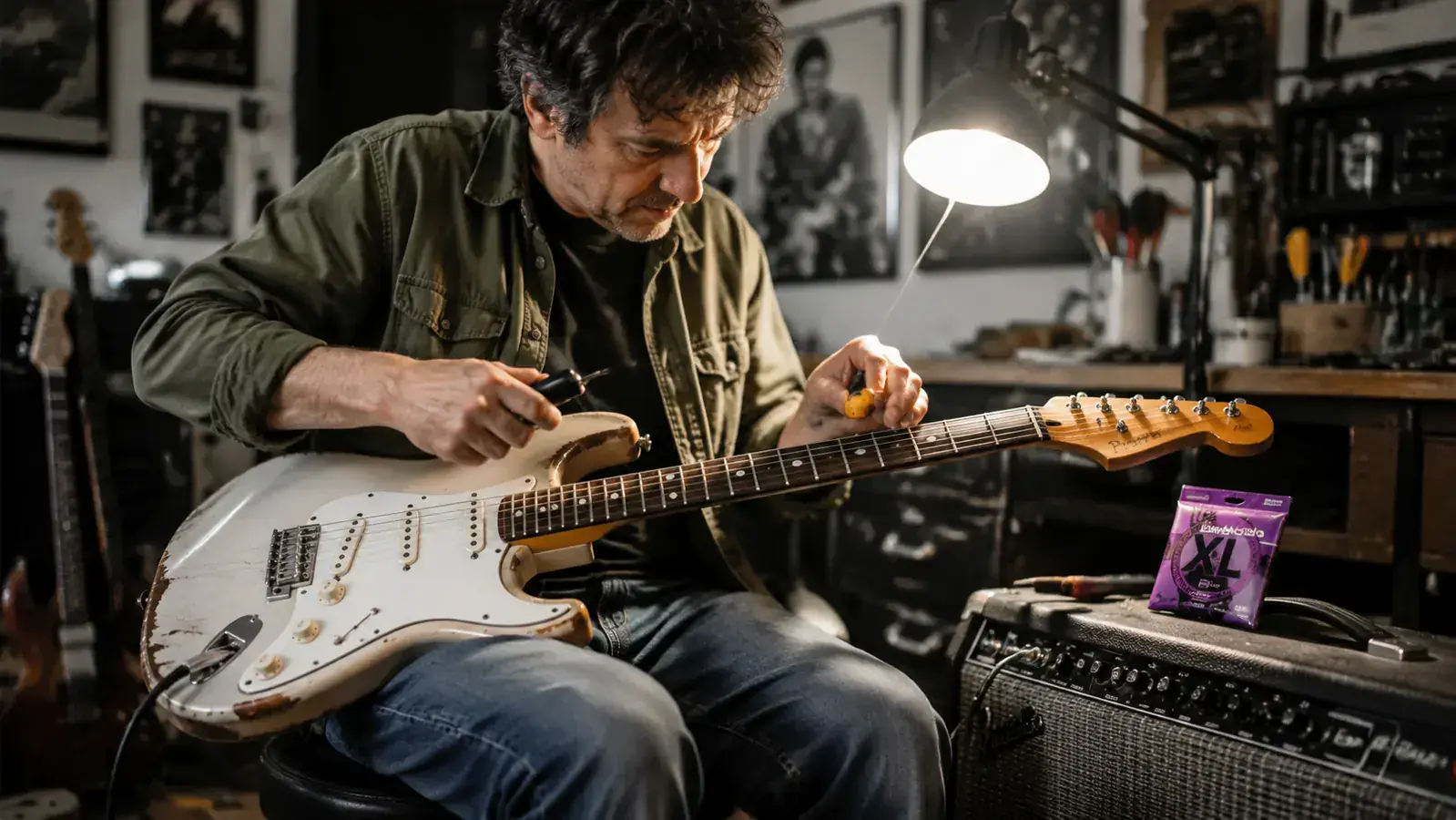
I put my first set of D'Addario EXL110s on a Strat sometime around 2012 and never really looked back. That sentence makes it sound like a love story. It is not exactly that. The EXL110 is not the most exciting string I have ever played. It does not make your Les Paul sound like Jimmy Page or your Strat sound like Hendrix. What it does, consistently, across dozens of restrings on four different guitars over more than a decade, is perform exactly the way a 10-46 nickel-wound string should: bright on day one, warm and musical by the end of the first week, predictable under bends, and honest about its weaknesses as it starts to die.
I am writing this from the perspective of a gigging player. I run two Strats and a Les Paul Standard through this site's regular rotation. One Strat lives at rehearsal space and gets played three to four times a week. The Les Paul is my studio guitar. The other Strat is the bedroom noodler. Each one tells a slightly different story about how these strings age, and I will walk through all of it. The short version first.
The Quick Verdict
The most consistent nickel-wound string at this price. Bright on day one, musical for weeks two through five, and the 3-pack makes the per-set cost so low that swapping frequently is no longer an excuse.
Amazon Check Today's Price →If you restring every 6-8 weeks for gigs, the 3-pack math is a no-brainer
At the current price, the EXL110-3D gives you three full sets. That is three restrings for roughly what you would pay for one premium set of coated strings. They ship in individual nitrogen-sealed pouches, so the sets you are not using stay fresh until you need them.
Amazon Check Today's Price on Amazon →How I Have Been Using These Strings
My methodology here is not lab testing. It is lived use. The rehearsal-space Strat has gone through roughly seven sets of EXL110s in the past year. I restring it every six to eight weeks, or immediately after any gig where I sweat heavily, whichever comes first. I play with medium-to-heavy pick attack, a lot of palm muting, and a fair amount of string bending in the 9th-to-14th fret range. The Strat runs through a Boss Katana at rehearsal and a small tube combo at gigs.
The Les Paul is on a different schedule. It gets restrung every four to five months because it mostly stays in the studio, climate-controlled, and I do not put nearly the same hand sweat on it. That gives me a useful data point: what do these strings feel like at month four versus week six? The answer is more nuanced than the YouTube reviewers let on.
I have also tried these strings on a 25-inch scale Squier Classic Vibe alongside the longer Strat scale, so I can speak to how they behave under slightly different tension. Spoiler: the shorter scale softens the feel noticeably, which matters for players with thinner fingertip skin or arthritis developing in the left hand.
Day 1 Through Day 7: That Bright Window
Fresh EXL110s have a snap to them. You put them on, stretch them in properly, and the high E and B strings ring with a glassy brightness that cuts through a band mix without any presence boost on the amp. The 10 gauge high E is responsive without being flimsy. It does not snap under a full-step bend the way some cheaper 9-gauge strings do, and it does not feel stiff like a 10 on cheaper Chinese-sourced strings sometimes can.
Day one through about day three is when these strings are at their most piano-like. Every note pings. The harmonics ring clearly. If you play clean passages or spend time doing lead work in the upper registers, this window feels great. For rock players who spend most of their time with gain cranked, the brightness is a little much on day one, honestly. I usually give a new set 48 hours of playing before I go near a gig with them. By day three to four the zing settles into something more musical.
By day seven, assuming four to five hours of play spread across that week, the strings have broken in to what I think of as their sweet spot. The top strings are still bright enough to cut but have lost that slightly harsh edge. The wound strings, particularly the D and A, start to show their midrange character, which pairs well with the natural warmth of a nickel pickup like a PAF-style humbucker.

Week Two Through Week Five: The Sweet Spot
This is where EXL110s live for most of your playing life if you are on a healthy restring schedule. Weeks two through five, assuming regular playing of four or more hours per week, are when these strings deliver the tone most nickel-wound enthusiasts are chasing. The wound strings develop a slight warmth that takes the harsh edge off overdriven tones without losing articulation. Palm-muted chugs on the low E and A strings feel satisfying, with enough thump to translate through a cranked amp without turning into a muffled blur.
Palm-muted chugs on weeks-old EXL110s have a density to them that brand-new strings do not. The wound strings develop a slight compression that actually feels better under a heavy right hand.
For hard rock and classic rock work specifically, this aged-in-slightly tone is more useful than the bright day-one sound. The G string, which is the plainest of the wound strings and often the weakest link on any 10-46 set, stays consistent across this window. I have not had issues with the G going uneven or buzzing on the EXL110 the way I occasionally have with budget strings. Intonation holds well during this period too, assuming the guitar was set up correctly when the strings went on.
Bending in the sweet-spot window is where the EXL110 earns its reputation. A full-step bend on the B string at the 10th fret feels smooth and returns to pitch reliably. I have used these strings on a trem-equipped Strat and found them forgiving enough that aggressive trem use does not throw them out of tune for more than a few seconds. That is partly the guitar's setup and partly the string's consistency under tension.
Week Six and Beyond: Sweat, Oxidation, and Knowing When to Stop
I am a sweater. Not a light-perspiration player. After a 90-minute rehearsal in a warm garage in Florida, my strings look like they have been through a light rain. That is a reality for a lot of gigging players in humid climates, and it is the main reason I restring every six to eight weeks rather than every four months.
By week six, if you play regularly and sweat normally, the EXL110s will show it. The wound strings start to darken. Under a bright light you can see the early signs of oxidation between the windings on the lower strings. The tone gets progressively duller. Not dead yet, but the clarity on single-note lead lines is noticeably reduced. Harmonics take more effort to coax out. The strings start to feel slightly rough under the fingertips as the winding texture changes.
At month four on the studio Les Paul, which does not see nearly the same sweat and humidity, the strings are still playable but the brightness is long gone. They have settled into a thick, warm tonality that actually works well for recording certain parts. Chunky rhythm tracks with a lot of midrange, old-school rock stuff where you want the strings to feel like they have been played for a while. But I would not track a guitar solo on month-four strings. The intonation starts to drift, particularly on the G and B strings, and no amount of saddle adjustment fully compensates for worn string mass.
Intonation Stability: Where EXL110s Earn Real Respect
One thing I want to flag specifically because I do not see it discussed enough: the EXL110's intonation stability during heavy bending is unusually solid for a string at this price. I play a lot of Albert King-style bends, whole-step and a half on the B and G strings. On cheaper strings, repeated heavy bending causes the string to go slightly sharp and stay sharp, throwing off the return pitch. It is a gradual stretch-out issue.
EXL110s resist this longer than most budget strings I have tried. D'Addario's manufacturing process involves computer-controlled winding that keeps string-to-string diameter consistency tighter than you get from hand-wound or loosely QC'd alternatives. I cannot prove this with a caliper, but the feel is noticeably more uniform across a fresh set. When I played Ernie Ball Regular Slinkys for a stretch in 2020, I found the EXL110s easier to intonate and more stable under bending. Your mileage will vary by guitar and setup, but that has been my consistent experience.
What I Liked
- Excellent intonation stability under heavy bending compared to the price point
- The 3-pack nitrogen-sealed pouches keep unused sets fresh for months
- Consistent string-to-string diameter makes setup and intonation dialing faster
- Sweet-spot tone at weeks two through five is genuinely musical for rock and hard rock
- 4.8 stars from over 20,000 reviews is not a marketing number, it reflects real-world consistency
- Low per-set cost makes frequent restringing a sustainable habit rather than a luxury
Where It Falls Short
- Day-one brightness can be slightly harsh for high-gain players, needs 48 hours to settle
- No coating means sweaty players will see these oxidize and die faster than coated alternatives
- The G string is the weakest link, as with most 10-46 sets, and can go slightly out of round if you bend it hard over a long period
- Not the choice if you want extended string life without frequent restringing
The 3-Pack Math: Why EXL110-3D Is the Buy
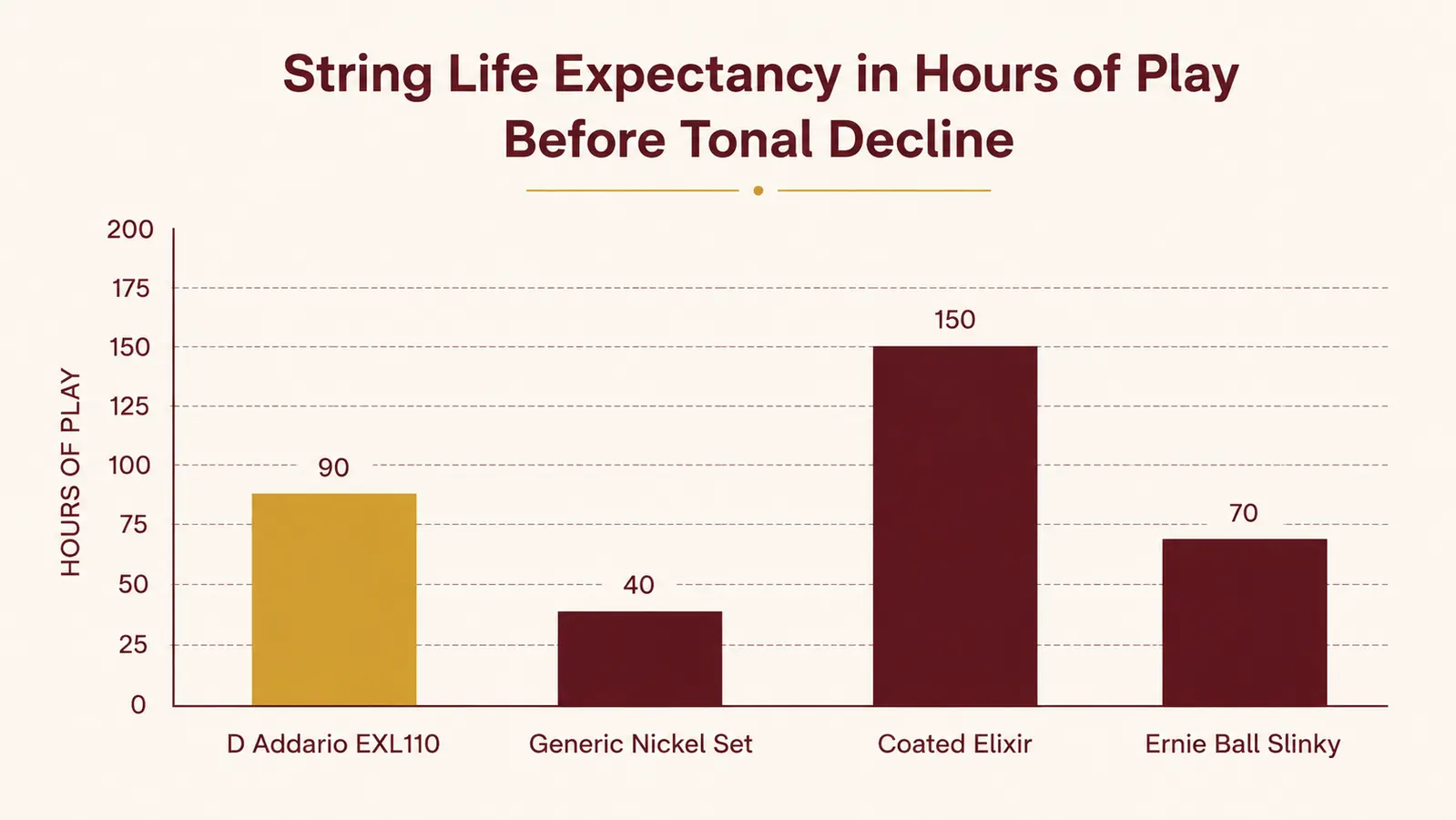
I want to dwell on this for a moment because it is genuinely one of the better value propositions in guitar gear at any price level. The EXL110-3D is three individually nitrogen-sealed sets. Nitrogen sealing matters because it prevents oxidation while the set is waiting in the envelope. A set sealed in nitrogen on its packaging date will play like a fresh set two or even three years later. I have tested this. I had a set from a bulk purchase in 2023 that I opened in early 2025 and it played identically to a set I bought the week before.
At the current price for the 3-pack, each set comes out significantly cheaper than buying individual sets, and cheaper than almost any other name-brand 10-46 set on the market. For a gigging player who restrings every six to eight weeks, buying the 3-pack means you are covered for four to six months with one order. That changes the relationship you have with restringing. It goes from a chore you put off because strings are expensive to something you just do on schedule, because the cost objection is removed.
I keep three 3-packs in my gear cabinet at any time. That gives me nine sets, which is roughly a full year of coverage for the rehearsal Strat plus the occasional emergency restring when a string breaks mid-session. I have never had a set from a sealed pouch fail to perform on install.
How They Sound on a Strat vs a Les Paul
The EXL110's character reads differently depending on what it is sitting under. On a Strat with single-coil pickups, the nickel winding of the EXL110 pairs well with the natural brightness of the pickups. The result is clear and snappy, the kind of tone that works for classic rock rhythm playing and lead work. On a Les Paul with PAF-style humbuckers, the same string sounds noticeably warmer because the pickup is already adding midrange. The combination gives you a full, slightly compressed voice that is excellent for '70s-style hard rock.
If you are playing a guitar with high-output active pickups or modern voiced humbuckers, the EXL110's nickel character may come across as slightly thin compared to heavier gauge strings. For that application, stepping up to a 10-52 set or a 11-48 set might serve you better. But for standard 10-46 rock work on any passive-pickup guitar, the EXL110 covers the territory effectively.
Who These Strings Are For
The EXL110 is the default string for a reason. If you play rock, hard rock, classic rock, or blues-rock on a standard-scale electric guitar, this string does everything you need it to at a price that makes frequent restringing realistic. It works on Strats, Les Pauls, semi-hollow bodies, and pretty much any guitar that lives in the rock guitar world. The 10-46 gauge is light enough for comfortable bending but substantial enough to drive a humbucker pickup properly. It is not a flashy string, but it is an honest one.
Who Should Skip It
If you are a sweaty player who wants strings to last six months without restringing, look at coated options like Elixir Optiweb or D'Addario's own NYXL coated line. The EXL110 without coating will oxidize and die within six to eight weeks of regular gigging for a high-perspiration player. If you play heavy downtuned rock and need the tension that a 10-46 cannot provide, a 10-52 or 11-48 serves you better. And if you are a very light touch player who finds 10-gauge strings stiff, the EXL105 or a 9-gauge equivalent might be more comfortable.
Those edge cases aside, for the majority of rock guitarists playing standard tuning on a standard-scale guitar, the EXL110 is the correct default choice. I have tried a lot of strings. Ernie Ball Regular Slinkys, GHS Boomers, DR Pure Blues, Dean Markley Blue Steel, Elixir Nanoweb. I keep coming back to the EXL110 because it does not surprise me, and for a gigging guitarist, surprise is not usually a compliment. You want to know what you are getting every time you install a fresh set. The EXL110 delivers that reliably.
Stock up on the 3-pack and stop dreading your next restring
The EXL110-3D gives you three nitrogen-sealed sets that stay fresh until you need them. For a player who restrings every 6-8 weeks, one order covers you for months. The per-set cost is lower than anything else in this class.
Amazon Check Today's Price on Amazon →